Showing posts with label film. Show all posts

Monday, July 18, 2011

The Last Battle


Harry Potter and the Deathly Hallows: Part 2 was, in my opinion, a fitting capstone to one of the greatest book-to-film adaptations of our time. Over the past decade, the Harry Potter movies have been more than a cultural phenomenon: it's a cultural force in its own right. Most often, when popular books make it to the big screen, the film becomes a point of origin for a line that divides the fanbase into "true fans" and those who just saw the movie. But I feel that this isn't the case with Harry Potter. Sure, there are plenty of fans who insist that you're not a true fan if you haven't read the books (and I'll admit that's a position I've taken myself, on days I'm not feeling particularly generous), but I feel that those who truly understand the spirit of the Wizarding World can accept that the movies are not necessarily a lesser experience than the books, simply a different one.

And let's be honest, if you've only seen the movies, then at least that's a step in the right direction. These films are some of the finest big-budget blockbusters crafted in our lifetimes, and they feature the cream of the crop of British actors. Any film series which manages to include the likes of Richard Harris, Maggie Smith, Emma Thompson, Robbie Coltrane, Gary Oldman, David Thewlis, Ralph Fiennes, Julie Walters, Brendan Gleeson, and the incomparable Alan Rickman deserves... well... I don't know what. Something big, anyway! Maybe their prize is just the chance to be connected with something so huge, so international, so important to so many people all over the world, both children and adults.

Difference is key. If the movies were exactly like the books in every respect, they wouldn't be nearly as much fun to watch. If I want to see Harry Potter and the Sorceror's Stone precisely as the author wrote it, then I can just reread the book. I've read that dialogue (and listened to Jim Dale read it) before; I don't need to pay ten bucks a head to see an actor read me a book that's already sitting on my shelf at home.

As always, John Green has interesting thoughts on book-to-movie translations, and the relative merits (and demerits) of remaining slavishly faithful to the source material. And hey, he conveniently agrees with me! What a crazy random happenstance!

We Potterites should be thankful for what we've gotten: eight amazing films, populated by the crème de la crème of British actors, and helmed by some of the best directors in the world, which not only bring our imaginations to the big screen, but allow us that most precious of all gifts: another glimpse, from an excitingly different vantage point, into the the enchanting, alluring, magical world of the Boy Who Lived.

To paraphrase Dumbledore: Don't pity the dead; pity the living. And most especially, pity those who go through life with only a single glimpse of Harry Potter.

Friday, April 1, 2011

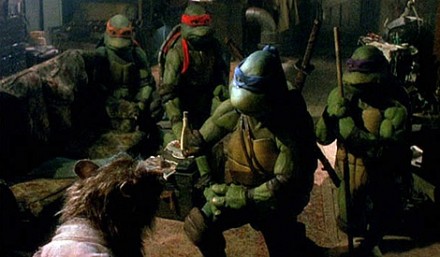
Animatronics: Not Dead, Just In Storage

When was the last time you saw a film (besides on DVD or through Netflix!) which boasted of using of "the most advanced animatronics available"? Or indeed, any animatronics at all? A long time ago, I'm willing to bet. Ten years? Maybe more?

To look at it from another angle, when was the last time you saw animatronics used in a real-life, face-to-face setting? Chuck E. Cheese's? Some ride at a theme park for a movie that left theaters fifteen or twenty years ago? Okay, I seem to recall encountering one or two robotic puppets at "The Wizarding World of Harry Potter", but they weren't true animatronics, just models of giant spiders attached to robotic arms.

Animatronics just don't seem to get the same amount of love they once did. The reasons for this are threefold:
1) animatronics are expensive, and once you've made one it's set in stone; you can't do a redesign if the creature doesn't test well with audiences;
2) animatronics contain thousands of moving parts, the malfunction of any one of which could cause the whole machine to cease working, leading to costly delays when filming must be halted while repairs are made; and
3) animatronics are subject to many of the same laws of physics which they attempt to overcome. For example, you can't build a three-story tall praying mantis animatronic for the same reason that a real three-story tall praying mantis wouldn't work: an insect that large simply could not support its own weight.

With these fairly major shortcomings in mind, it's no wonder that filmmakers have turned to CGI to satisfy their needs in the special-effects department.

But I feel that animatronic animals and characters have several advantages over CGI. Advantages which suggest that animatronic technology is not yet dead, nor yet completely outdated.

Number One: Animatronics will always look real.
This one gets swept under the rug a lot. When making a film, the director's primary concern is to get the movie finished on-deadline and under-budget. Everything else is secondary. But what director doesn't want their movies to look good for future audiences, when their films are being displayed by historical societies or film-school professors? The temptation to not just do well, but to leave landmarks for those who follow in one's footsteps is a powerful desire in many directors.

For proof, one simply needs to look at Star Wars.

Pop a copy of Episode I into your DVD player, and take a good look at Jar-Jar Binks. (I know it hurts. Just bear with me for a moment.) Look at how he moves, how he interacts with the objects and actors around him. It doesn't quite look right, does it? Kinda... floaty, right? Like he's not really there? Jar-Jar was created just twelve years ago, using the most advanced CGI technology that had ever been assembled at that time. Barely a decade has passed, and he already looks fake.

Okay, now eject the disk, invite a priest over to purify your entertainment system, and pop in your DVD of Star Wars: A New Hope. Take a good hard look at Chewbacca. He looks really solid, doesn't he? He makes fluid motions, casts realistic shadow-effects, and has a palpable stage-presence. That movie is twenty years older than Episode I, yet Chewie still looks more realistic than Jar-Jar ever could. Why is this? It's because Chewbacca was actually there on the set! Which brings me to my next point,

Number Two: Animatronics have superior stage-presence to purely-CGI characters.


When a CGI character interacts with a flesh-and-blood actor, in almost every case the actor was playing to an empty room, or a blank green-screen. As any actor will tell you, playing a part, any part at all, without another human presence to judge by and interact with, is an extremely difficult endeavor. Even if there was a man in a skintight greensuit standing where the monster's going to be in the final version, it's not the same as actually having the monster standing right in front of you, roaring and spitting venom in your face.

Number Three: Animatronic characters have a warmer, more human appearance.
Even if the character in question is not human at all, animatronics often induce much greater feelings of affection in audiences than any CGI character. Because the machines are bound by the same laws of physics as we are, their motions, by definition, look real and natural. While animators are busy trying to figure out how to convey a sense of weight and solidity in their creations, all a puppeteer needs to do is hit the "ON" switch and play around for a few minutes.


Furthermore, the fact that a puppeteer (or team of puppeteers) controls the machine's every motion means that all their motions will be infinitely more human. The animators don't need to search for the key to simulating natural movement; it's sitting right in front of them, waggling its ears and making faces at them.

Monday, February 14, 2011

Movie Review: "How To Train Your Dragon" (2010)


At first, I was tempted to review this film as a cynical adult; that's not just my duty, since I'm writing this review (presumably) for other similarly-cynical adults, it's also really the only way I can approach films anymore. I can't go back to the innocent days of yore, when anything with a dragon in it was considered praiseworthy. But I feel that writing this film off simply because it doesn't try anything new in the story department would be giving it short shrift.

How To Train Your Dragon never really attempts anything revolutionary, doesn't throw the audience any curveballs, but what it does, it does well. The animation is top-notch, and numerous times during the flight segments I was struck by an intense desire to see it in either 3D or IMAX. Both, if possible. Alas, the movie is several months old now, and the moment has passed. So it goes.

The story follows Hiccup, a young teen with an American accent in a small island village of Scottish-speaking Viking warriors. For some reason, the difference in accent is never brought up; in fact, all the kids in the village have distinctly American speech patterns. Maybe you need to get a permit for your brogue, to show you can handle the responsibility?

Hiccup is a scrawny, skinny boy, which is a common feature of YA protagonists, but somewhat unusual in a blacksmith's apprentice. His father, Stoic the Vast (voiced, appropriately enough, by Gerard Butler, that bearded Scotsman of 300 fame) is the chief of their village, which is pillaged on a near-nightly basis by marauding dragons.

During one of these raids, Hiccup is trying out a net-launching apparatus of his own design, when he gets off a lucky shot and snags a Night Fury, a mysterious black-scaled subspecies of dragon with incredible speed and firepower. Naturally, no one believes that such a loser kid could catch a dragon that no one's ever seen and lived to tell the tale. So Hiccup sets off into the woods to find his rightful kill.

... Only he finds that, when the dragon is lying helpless before him, he can't bring himself to kill it. He sets it free, but it's been too badly injured by his net to leave the box canyon where it fell. Thus begins a tale of friendship, prejudice, war, personal growth, and teamwork.

The dragon, "Toothless", is an impressive feat of CGI. He's tough and weighty without being bulky, powerful without being scary, and a weird fusion of reptile, bird, and dog. Best of all, he remains a convincing animal throughout the film. By this, I mean that the animators and writers never lose sight of his animal nature; even though he's friendly, he's not all sunshine and roses.

It's a fun story. It's funny. It's touching. It's even a little bit romantic (if you like girls who like punching boys). I'd say that it's worth buying a copy for your kids. Even if you don't have kids, you might want to check it out. You might find that what appeared at first to be distasteful is actually a lot of fun.