Showing posts with label superheroes. Show all posts

Monday, February 19, 2018

[Film Review] Black Panther

Image result for black panther poster

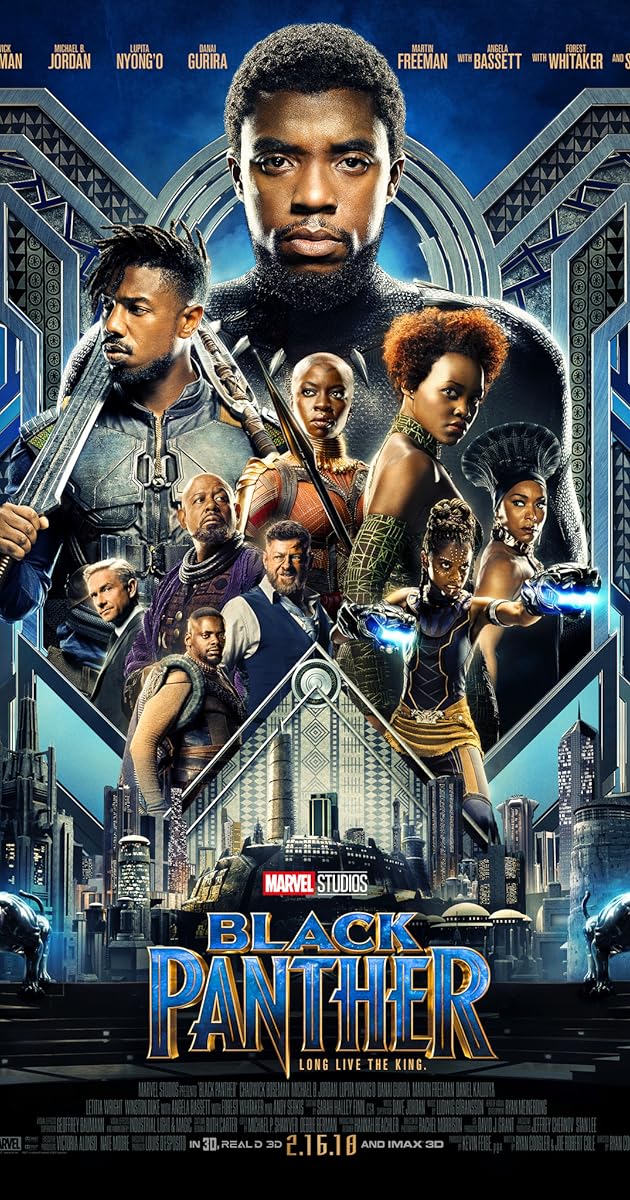
If you're a white boy (or girl) like me, this is likely to be your first foray into Afrofuturism. I think it might be for me, though I can't be sure -- it's not like there's a comprehensive Afrofuturist Registry or whatever. But whether it's your first encounter with Black-created science fiction or your thousandth, Black Panther offers something I can promise (with reasonable certainty) that you've never seen before: a big-budget Hollywood blockbuster movie, created by Black authors, artists, and actors, tied into a major and extremely popular shared cinematic universe, in which Blackness is not only prominent, but portrayed positively and in a way which is central to the story. Black Panther goes to places I never expected to see a Hollywood movie deal with in such a frank manner, and even goes so far as to point the blinding cultural spotlight that is the Marvel Cinematic Universe towards some disturbing and controversial truths.

Yeah, that's right: this movie asks you to consider some uncomfortable facts about race in America, Africa, and the African Diaspora. Deal with it. You'll still get to see awesome fight scenes, top-notch special effects, and subtle nods to Marvel Comics and MCU history. It's not all sad-times and serious business: there's plenty of domestic comedy, explosions, and affectionate kisses from battle-rhinos to keep you entertained.

[This review will contain mild spoilers for the first act of Black Panther, but I'll do my best not to ruin the major surprises for you.]

The tale begins with a visually-stunning infodump which explains the history of Wakanda and its massive deposits of the super-metal vibranium, as well as their decision to conceal their technological prowess from the rest of the world, and how they came to select the first Black Panther as their king. Since then, the title of king-and-Black-Panther has passed from father to son in the royal line: upon the recent assassination of King T'Chaka (John Kani) in Captain America: Civil War, the mantle passes to his son, Prince T'Challa (Chadwick Boseman).

Image result for black panther
Women are well and strongly represented; most of T'Challa's
entourage, from his bodyguards to his tech guru, are female.
(From the very first shot, I was reminded of that scene from the beginning of Roots, in which newborn Kunta Kinte is held up to take his first look at the night sky by his father, who tells his infant son "Behold! The only thing greater than yourself." In a way, Black Panther is a love-letter from Black parents (and aunts, uncles, big brothers, and big sisters), to the next generation of Black children, saying "Behold! This is how awesome your future could be; make it so.")

After that we jump ahead to Oakland, California in 1992, where King T'Chaka shows up unannounced, surprising his younger brother Prince N'Jobu (Sterling K. Brown), who has secretly been arming people of African descent with Wakandan weaponry in order to bring about revolution. T'Chaka is forced by this betrayal -- and N'Jobu's attempt on the life of T'Chaka's adviser -- to kill his younger brother, an act which will have dire consequences for T'Chaka's kingdom . . . and for his son in particular.

Next we skip ahead to the modern day where T'Challa ascends to the throne after a quick round of ritual combat. He learns that Age of Ultron villain Ulysses Klaue (Andy Serkis) -- who recently stole a sizable chunk of Wakandan vibranium and killed several people in the process -- has resurfaced in Busan, South Korea, which prompts T'Challa to round up a posse -- consisting of his ex-lover Nakia (Lupita Nyong'o) and his chief honor-guardswoman Okoye (Danai Gurira) -- and head out to bring him in. This plan of course goes south, forcing T'Challa to return empty-handed . . . or nearly so. CIA operative Everett Ross (Martin Freeman) gets caught in the crossfire of Klaue's escape (which is effected by one Erik "Killmonger" Stevens (Michael B. Jordan), a former U.S. black ops soldier and son of Prince N'Jobu, making him T'Challa's cousin), and T'Challa decides they can't leave the man to die from wounds he sustained in "their" fight. So they pack Ross onto their quinjet and take him back to Wakanda for a round of super-healing . . . which entails exposing their country's technological superiority to an outsider (and a white guy to boot!)

Image result for killmonger
Michael B. Jordan lends villain Erik Killmonger a formidable emotional range,
from a scary-intense calm to a bitter, wrathful spite.
But of course, things go from bad to worse when Killmonger shows up unexpectedly in Wakanda, revealing his hidden heritage and, by dint of his royal blood, challenging T'Challa for the throne . . . and the mantle of the Black Panther!

Alright, that's all the storyline I'm gonna spoil for you. Onward, to the review!

I don't think I've ever seen a movie with a token white guy before: it was an interesting inversion of the status quo. I also think it was a smart move on the writers' part, because by making a White man (Martin Freeman) one of the good guys, they preclude the inevitable racist braying that the film demonizes White people. The film doesn't exclude White people, neither from the protagonists nor from the antagonists, it simply takes the logical step of casting a movie set mostly in Africa with mostly people of African descent. Seems perfectly reasonable to me.

Killmonger is unusual for a Marvel villain: instead of being crazy-eyed psycho or a moustache-twirling omnicidal tyrant, Killmonger is calm and soft-spoken, almost scarily calm: a marked departure from his depiction in the comics, where he's about as restrained as Hulk Hogan. The villain was actually one of the film's strongest points (and Black Panther has a great many strong points). While he's unquestionably evil and clearly not interested in what's best for Wakanda -- or anyone else, including himself -- once we learn his backstory, he becomes . . . not exactly sympathetic exactly (we can't agree with his methods, or even his goals), we can at least understand what made him so fucked-up in the first place, and feel bad for him and his misfortune at the hands of an unjust system and his betrayal/abandonment by the people (his own flesh and blood) who should have taken him in and cared for him. 

Black Panther doesn't shy away from uncomfortable truths about the African condition, both in Africa itself and across the globe (e.g., black-on-black crime, institutionalized racism, stereotyping, the need for Pan-Africanism, etc.) As Killmonger points out (as near as I can remember the quote), "Y'all sittin' up here comfortable [while] there's about two billion people all over the world that looks like us, but their lives are a lot harder [than yours]."

Killmonger is unusually philosophical for a Marvel villain: his words (especially his final line of the film) will stay with you long after Black Panther is over. Just make sure you stay until the very, very end.

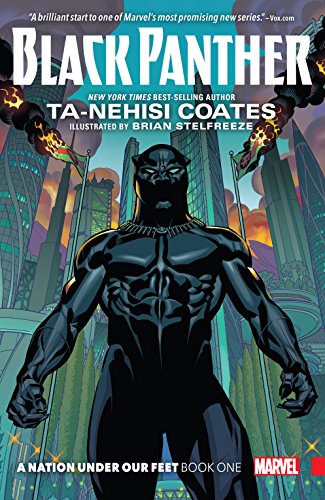
Image result for black panther

Wakanda forever!

Wednesday, February 7, 2018

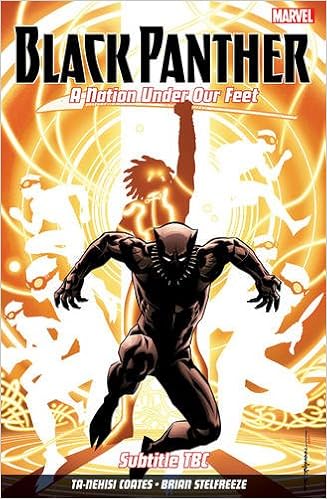
Black Panther: A Nation Under Our Feet - Books One and Two

Image result for Black Panther: A Nation Under Our Feet

Black Panther: A Nation Under Our Feet - Books One and Two (Marvel, 2016)
Writer: Ta-Nehisi Coates
Illustrator: Brian Stelfreeze
Colorist: Laura Martin
Letterer: Joe Sabino

One of my New Year's resolutions was to get through my huge backlog of reading material, which by necessity entails NOT adding even more books to my already-overstocked reading list. Which is why I can't say that I planned to read Ta-Nehisi Coates' newest addition to the Marvel Universe, it just kind of happened one day when I saw these sweet-looking comics on display at my local library, just sitting there... tempting me... with their topicality and sick cover-art and Ta-Nehisi's name up there on the cover like some big... tempty thing.

Besides, I'd never read a Black Panther comic before, so I figured it'd be an interesting new experience. It's background reading, so you can appreciate the movie better, I told myself. It'll count as "doing something for Black History Month" or whatever.

Image result for black panther: A Nation Under Our Feet

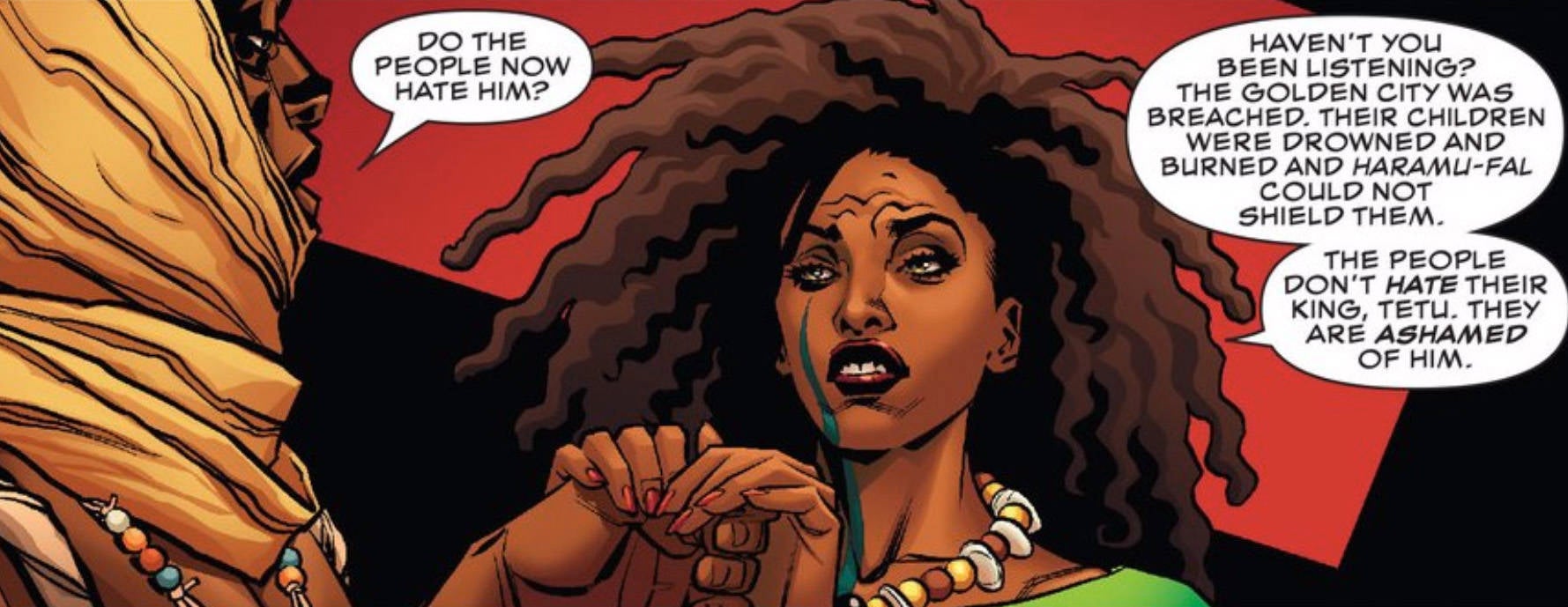
This being part of the Marvel Universe, the tale begins in medias res - or rather, ex post facto: Wakanda, the African nation of which T'Challa (a.k.a. the Black Panther) is king, has just endured a series of deadly calamities: a Biblical flood instigated by Namor the Sub-Mariner, an invasion by Thanos, and a coup d'état by Doctor Doom which left T'Challa's sister Shuri, the previous Black Panther, trapped between life and death. The country is in chaos, and many Wakandans feel that their king has failed to protect them, and that therefore he "is no king at all". The sorcerer Tetu and his mind-witch Zenzi feel that monarchy has served Wakanda poorly, and so they stir up anti-royal, pro-democratic sentiment among T'Challa's subjects to fuel their Nigandan-backed revolution. Meanwhile, two of the Dora Milaje (the king's all-female honor guards) have gone rogue: after Aneka murders a serial rapist in an extra-judicial killing and is sentenced to death for undermining the rule of law, her lover Ayo steals a pair of prototype exoskeletons and breaks Aneka out of prison. Dubbing themselves the Midnight Angels, the two set off on an anti-rape rampage across Wakanda's lawless hinterlands, murdering bandit-kings and sexually-abusive patriarchs without trial or mercy. T'Challa is forced to hunt down and apprehend two of his own beloved and loyal servantswomen with whom he agrees on the righteousness of their cause, in theory if not in practicein order to preserve the rule of law in his own kingdom.

Image result for black panther: A Nation Under Our Feet

One of the things I really like about A Nation Under Our Feet is that no one could really be called a "villain", at least not in the traditional, mustache-twirling sense. Sure, there are minor characters like the White Gorilla and Zeke Stane (son of the villain from the first Iron Man movie) who you just love to hate, but for the most part all of the people working against Black Panther have sympathetic goals, even if we don't agree with their methods. What American reader could hear about an attempt to overthrow a hereditary monarchy and replace it with democracy and not feel at least a little affinity for their cause? What person with a heart could hear about systematic rapists being murdered by the very women they abused without feeling at least a twinge of poetic justice? Much like Game of Thrones, the reader is never sure who to root for, because we know that victory for one side means defeat for another faction with which we sympathize.


In fact, Coates makes us wonder for a while whether T'Challa is even the guy we're supposed to be rooting for. In Book Two, in a desperate attempt to restore order to his rapidly-disintegrating country by any means necessary, T'Challa recruits a consultancy team made up of the worst of the world's leaders: men who employ spies and torturers and even outright terrorism against their own people to maintain their own fragile grasp on power... and he asks them for their advice! T'Challa even uses nanobot technology of questionable origin (i.e., Doctor Doom) to enhance his own search for his sister's wayward soul. Speaking of whom, Book Two is interlaced with Shuri's story, as her soul journeys through the Djalia, the spiritual plane of Wakandan memory, where she learns the history of her people from a griot-spirit while simultaneously coming into her own, truer self. Book Two also sees the Panther teaming up with The Crew, an all-Black team of superheroes including Luke Cage and Storm, who help T'Challa raid a terrorist hideout in the grand, over-the-top, bullets-flying-in-your-face tradition of the very finest blaxploitation films of the 1970s.

At times, the use of Wakandan vocabulary was confusing. Words like jabari, mjinga, and jambazi are just tossed off by the cast without any explanation or easy way to look them up. At first I thought I could guess what they meant from context, but I kept coming across clues that made me think I had got it wrong. I realize that this is how people talk, without constantly explaining themselves, but a Wakandan dictionary, or a glossary at the end of the book, would have been nice.

Speaking of extras at the end of the book, both volumes feature "Process & Development" sections which include samples of character art, rough sketches of individual characters and entire pages, and excerpts from Coates' script. These bonuses are kind of interesting, but they won't really teach you anything new about how comic books get made.

Related image

Finally, each volume ends with reprints of classic Black Panther issues. Book One includes the Panther's first-ever appearance in Fantastic Four #52, a fun romp through a techno-organic jungle populated with deafeningly-bright primary colors and Jack Kirby's trippy, mechano-fantastic visuals. Book Two concludes with two issues of Panther's Rage, a 1973 adventure-tale which is extremely, at times hilariously, 80s. The main villain, Erik Killmonger (yes, that's his actual surname), is a bare-chested, spike-wearing, whip-wielding African giant who appears to dunk his entire head in a bucket of Soul-Glo every morning.

think this is the first time the Black Panther has had both a Black writer and a Black illustrator at the same time, though I can't swear to that. Either way, Coates and Stelfreeze work well together, and I look forward to seeing more from this pairing. Coates' storytelling is excellent (A Nation Under Our Feet was nominated for a Hugo award for Best Graphic Story), but there are occasional resorts to well-worn comic book cliches (faked deaths, infodumps, deliberately misleading the reader, etc.) to heighten drama. I also found the story in Book One a little difficult to follow; I had to read it twice before I fully understood all the players and their various motivations, but Book Two flowed much better, once all the exposition was out of the way.

Overall, Black Panther: A Nation Under Our Feet is a rollicking adventure yarn which doubles as subtle political commentary. Under the guise of discussing the myriad troubles which beset this fictional African country, Coates surreptitiously introduces and explores topics which are near and dear to his heart, such as internalized racism, statecraft and kingship, and what it is that truly makes a country (and its king) great:
T'CHALLA: The day after I became king, [my uncle] S'Yan offered a single piece of wisdom. "Power lies not in what a king does, but in what his subjects believe he might do." This was profound. For it meant that the majesty of kings lay in their mystique... not in their might. Every act of might diminished the king, for it diminished his mystique. Might exposed the king's powers and thus his limits. Might made the king human. Breakable. [...] [W]hat the people know not is the true power of kings.