Showing posts with label vampires. Show all posts

Wednesday, July 25, 2018

[Book Review] Lord of the Vampires

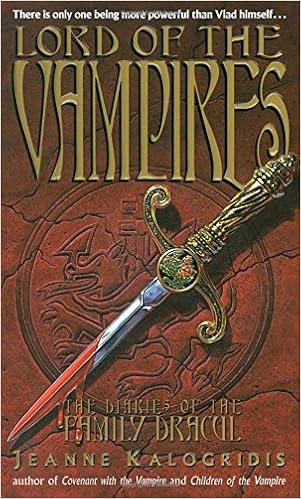
Image result for lord of the vampires jeanne kalogridis

Lord of the Vampires, by Jeanne Kalogridis
(The Diaries of the Family Dracul, Book Three)
© 1996 Dell Publishing

Jeanne Kalogridis' capstone to her Diaries trilogy takes place concurrently with the events of Bram Stoker's Dracula. In fact, Lord of the Vampires offers an entirely new take on many of the events of that famed seminal novel of vampire fiction, providing more than just new insights on Stoker's existing canon, but entirely new, previously-unseen aspects, characters, and plot-points.

Well, perhaps "entirely new" is a bit of an overstatement. Kalogridis never adds completely new characters out of whole cloth; she has too much respect for Stoker to do that. Instead, she dramatically expands on what were previously unnamed background characters -- such as Dracula's three "brides" or Van Helsing's mysterious friend Arminius -- fleshing them out into fully-rounded characters with their own psychologies, motivations, and story arcs. As a result, we see Dracula, which was already a novel of many viewpoints, from the points of view of new characters, or from the same characters but with new information: for instance, we learn that Dr, Seward's wax cylinder dictations, which comprise his contributions to the original novel, only told part of what he knew. Here, Kalogridis makes us privy to his private, hand-written journals, which reveal that he (and his mentor, Prof. Van Helsing), know considerably more about vampirism in general and Vlad Dracul in particular, than the original novel suggested.

Related image
Professor Abraham Van Helsing, MD, D.Ph., D.Litt., etc, etc.
Speaking of whom, Van Helsing is present for many more of the events of Dracula than we had previously been led to believe. As a result of the hypnotic and mystical powers which he acquired under the tutelage of the mysterious sage Arminius in the previous novel, Van Helsing is able to render himself invisible to (most) mortal eyes, allowing him to play an unseen part in many scenes for which he was not present in Stoker's novel, such as the scene where Dracula kills Lucy and her mother. Usually these kinds of changes only result in minor, cosmetic differences to the scenes, but sometimes his presence (or the presence of other, similarly-invisible beings) casts old scenes in a completely different light. Which is important, because the author is working within a tight framework of restrictions.

By writing a novel that takes place within the events and context of another novel -- and an extremely famous one at that -- Kalogridis has taken on the difficult task of trying to surprise her readers while telling them a story they've heard many times before, without changing too much of the story or introducing elements which break her audience's suspension of disbelief. If she adheres to Stoker's plot too slavishly, the audience will get bored; if she changes things too much, they'll get angry and defensive. Fortunately, Kalogridis manages to strike a delicate balance between old and new, crafting a tale which manages to bring us back to familiar ground while simultaneously making it seem new and exciting.

Lord of the Vampires introduces something new to the series: a sense of pathos, of real human suffering. Not just supernatural cruelty (though there is plenty of that), but a peek into the houses of the dying. Early on we learn that Van Helsing's mother, Mary Windham-Tepesh, is dying of cancer, and we see in intimate detail just how devoted her son is to caring for her through even the most piteously gruesome aspects of late-stage cancer. Much attention is lovingly paid to the mood in the Westenra household as Lucy lies dying: we see the heartache and the pain which it brings, but as Van Helsing observes: "in the midst of gloom shines a ray of love and valour. . . . the experience [of caring for a mortally ill family member] melts away the more superficial aspects of the personality, revealing a golden core of strength and compassion."


Image result for elizabeth bathory
Pictured: One bad mofo
This, of course, is in stark contrast to the glamorous beauty and shocking depravity of the newest major character in the series, one Elizabeth Báthory, the infamous "Blood Countess" who (allegedly) tortured more than six hundred female servants over a period of decades and bathed in their blood to maintain her own beauty (consider yourselves trigger-warned for torture scenes and lesbian blood-orgies). Elizabeth shows up at Vlad's invitation to Castle Dracula, where she promptly restores both his and Zsuzsanna's youth and vigor (they having been trapped within Castle Dracula for the last twenty years, since the end of the previous book) and then gets screwed over by Vlad as he abandons them with only poor little Jonathan Harker as their last meal, who promptly escapes. Zsuzsanna and Elizabeth, seeking their revenge on Vlad, break out of Castle Dracula and pursue their erstwhile benefactor to England, where they work together in secret to destroy him (and their hated foe, the vampire-hunter Van Helsing).

In some ways, Lord of the Vampires is like those episodes of Game of Thrones that diverge from the books they're based on: what seemed predictable is suddenly no longer following the path which we expected, and this creates cognitive dissonance and dramatic tension. What was once familiar is suddenly, disconcertingly unfamiliar. Although it's sometimes a little maddening to see Van Helsing or Zsuzsanna being secretly present in familiar scenes yet unwilling to do anything to change their outcomes (for reasons which seem flimsy at best), Lord of the Vampires is overall an interesting second-take on a very well-known story, which forces us to pause and reconsider whether we actually know it all that well (or whether we know the whole truth of it). Many have commented about the logical inconsistencies of Dracula ( the vampire's inconsistent powers and weaknesses, his abysmal impulse-control, Van Helsing's shocking willingness to leave Mina undefended and ignorant of the truth), and this book does go a long way towards explaining some of these decisions, as well as providing more insight into the psychology and motivations of one of literature's greatest villains.

Sunday, January 7, 2018

[Book Review] Covenant with the Vampire

Related image

Covenant with the Vampire, by Jeanne Kalogridis
(The Diaries of the Family Dracul, Book One)
© 1994 Dell Horror

It's been a long time since I read Bram Stoker's Dracula, but this prequel, set fifty years before the events of that tale, brought back to me with vivid clarity the creeping dread and shocking horror of the Dracula mythos. Part of Dracula's allure is his ambiguity, his inability to be defined, the impossibility of pinning down exactly who -- or even what -- he is. Is the vampiric antagonist of Bram Stoker's 1897 Gothic horror novel truly the same person as the historical Vlad Tepesh, Vlad the Impaler, or is he just some random undead who's putting on airs? Is he even just a vampire, or does the hair on his palms and his ability to turn into a monstrous wolf make him also a werewolf?

I was a little afraid, at first, that revealing the "origins" of Count Dracula might dampen his mystique. Monsters frighten us because they represent unknown quantities; once you label and categorize them, once you assign them a backstory and a clearly delineated set of powers, they go from terrifying existential horror to monster of the week. Fortunately, revealing some (but not all) of Dracula's origins and motivations does nothing to diminish his power to terrify audiences, at least in this instance.

I was impressed and pleased to discover that Covenant with the Vampire is written, like the original Dracula, as an epistolary novel (or "novel made of letters"), with each chapter taking the form of a diary entry from one of the main characters. This use of multiple viewpoints and voices lends the novel texture, plus credibility as each character's account of events corroborates or expands upon that of the others. It also sets us up for a lot of dramatic irony: being privy to the inner thoughts of each of the main characters, we (the readers) inevitably know more than any one character is ever aware of, which means that we can only watch in mute horror as characters take actions and make decisions which we, knowing better than they, wish desperately to warn them against. The diary-entry format also gives us a sense of immediacy and urgency, as the characters explain to us where and when they are recording their thoughts: on sleepless candlelit nights, on scraps of paper stolen between visits from a nosy sister-in-law, on sunny mornings that make it difficult to trust one's own memories of the night before.

The story begins on "5 April, 1845" as Arkady Tsepesh, last male scion of the family Tsepesh (descendants of the infamous Vlad the Impaler), returns with his heavily-pregnant English wife, Mary Windham Tsepesh, to his ancestral home, Castle Dracula, following news from his deformed elder sister Zsuzsanna Tsepesh that their father has fallen gravely ill. Arkady and Mary arrive mere hours after his father's passing, and it is during the vigil for the deceased that we catch our first glimpse of Great-Uncle Vlad.

As you've probably guessed already, "Great-Uncle" Vlad is really more
of a great-great-great-great-great-great-great-great-great-great-great-uncle.
Over the course of a mere two weeks in the Transylvanian mountains, Ms. Kalogridis ever-so-slowly peels back the façade of normalcy, revealing a world of incest, torture, mass-murder, and of deals with devils both figurative and literal. As Arkady learns more and more of Great-Uncle Vlad's peculiar behaviors and future goals (e.g., moving to England with its "teeming millions"), and Mary begins to listen with increasing credulity to the whispers of the servants, and Zsuzsanna begins to attract -- and even to invite -- the sexual attentions of her wicked uncle, the net which entraps our characters within Castle Dracula and its estate grows ever-tighter. Mary's complicated pregnancy (to say nothing of the castle's extreme isolation and Vlad's increasingly controlling nature) prevents them from leaving freely, and so husband and wife are forced to bide their time and pay homage to a monster in their midst, a wolf in boyar's clothing.

"You look different, Uncle Vlad: have you done something with your heir?"
As Vlad begins to feed with greater regularity, he transforms from a decrepit relic into a terrifying patriarch; likewise, Castle Dracula itself transforms from Arkady's beloved-though-gloomy childhood home to a macabre prison, filled with and surrounded by secrets and death. As Vlad begins to seduce his many-times-removed grand-niece, we are given a firsthand account of what it actually feels like to become strigoi, in all the sensual and incestuous details -- though on a technical note, does it still count as incest if she's eleven generations removed from you? (Actually, don't answer that.)

As Arkady explores the estate and its grounds in pursuit of fleeting glimpses of his long-dead brother Stefan, he makes a grisly discovery in the woods beside Castle Dracula which results in what the old Ravenloft setting would call "a malign paradigm-shift", in which everything he knew, or thought he knew, about his uncle, his family, and the very nature of reality itself comes crashing down around his head. I can't tell you any more without giving too much away, but suffice it to say that if you're a fan of the creepy, the macabre, and the outright horrifying, Covenant with the Vampire will amply satisfy your disgusting predilections (you nasty little pervert, you).

As readers, our foreknowledge of what ultimately happens in Bram Stoker's Dracula -- that any attempts to kill Dracula are doomed to failure, that he must produce at least three "brides" and turn poor, mad Renfield into his creature, that at some point his mortal servants must abandon him and his castle to fall to ruins -- has the effect of producing great dramatic tension. We know that these things must occur in order for Stoker's narrative to make sense, but knowing that the blows must come but not knowing how or when they will fall, or in which order, may be the cruelest torture of all. 

Monday, September 21, 2015


A Girl Walks Home Alone At Night (2014)
Director/Writer: Ana Lily Amirpour
Starring: Sheila Vand, Arash Marandi, Marshall Manesh

The very first line line of spoken dialogue in this movie comes from a young boy, asking "Can I have some money?" Which is highly appropriate, because the director took mine. Or rather, she would have, if I had followed my initial impulse to see it in theaters instead of waiting for it to be available at the library. If I'd wasted both an evening and my money I would be quite put out, but since as it turned out I only lost 99 minutes I can't be too upset with myself.

I could easily imagine shots from A Girl Walks Home being used as the backdrop for an episode of a prime-time family sitcom. You know the episode: the wife wants to go see the new art-house film at the Historic Downtown Theatre, but her blue-collar husband doesn't like foreign movies. But not wanting to appear uncultured or xenophobic, he pays for their tickets anyway, and we get to watch him squirm in his chair as his every fear is proven right and made painfully, inescapably real. It could almost be funny, except the only genuinely funny thing in this entire movie is one brief shot of a young female vampire riding a skateboard while wearing a chador.

Whee.

It feels almost like the director was trying to collect every negative stereotype of foreign films in one place. For starters, Girl is an ultra-low-budget affair, and filmed entirely in black-and-white. There are subtitles (the dialogue is all in Farsi, even though it was filmed in California). All the characters are either shallow assholes, depressed and listless, slowly losing their youth, drowning in existential ennui, dying of terminal illnesses, or already dead. The scenery is all rusting industrial complexes, deserted city streets, or squalid apartments. Not a single person in this movie is enjoying themselves, not even the vampire.

Dialogue is delivered laconically, in one- or two-word statements interspersed with several seconds of painfully awkward silence to space them out. At one point, the leading male ("Arash") makes out with the titular girl in her subterranean apartment (to the lively tune of Death by The White Lies), but the director manages to make three actions (the girl puts on a record, turns around, then they make out) take what I think was the entire five minutes that the song lasts. I get that one of the participants in this makeout session has literally all the time in the world, but there is just no way that any teenage boy could delay gratification for that long. It feels like the director found what she knew, just knew was the absolute perfect song to go with this scene, but she didn't have enough dialogue to fill  the scene and couldn't afford to bay the band to shorten it, so she just told her actors to do everything with excruciating slowness to kill time, so their actions sync up with the song.

While it's true that many real-life conversations do contain a lot more silence that we realize, the reason movies are interesting is because they cut that stuff out: they condense life into a faster-paced, better-edited version of itself.

Despite the agonizing length of this movie, almost none of that time is used to fill us in on the backstory or to give context. Near the end of the very first, scene, Arash walks past what appears to be a drainage ditch full of human bodies. This is never explained, mentioned, or commented-upon by any of the characters, not even news or radio anchors heard in passing. Except for one shot in Act III where there are a larger number of bodies in the same ditch, and one additional body is being tossed unceremoniously into it.

Girl is full of non-sequiturs, loose ends, and the unexplained. For example, the transition between Acts II and III is a two-minute sequence of a drag queen in a black cowboy-shirt ballroom dancing with a Mylar balloon in an empty, abandoned courtyard. Just like the ditch-full-of-bodies from earlier, this is also never explained, commented-upon or explored, and the drag queen is never seen or alluded to again.


This was your cue to run, bro, not to erotically stick your finger in her mouth. What did you think was going to happen?

The posters and flyers all billed this movie as "[t]he first Iranian Vampire Western ever made," but being filmed in California, even the dusty part, does not a Western make. Girl does not exist within the milieu of the Western genre; if Girl is a Western, then so is Bad Santa, which at least is set in Phoenix, AZ and featured a bank robbery (of sorts). I suspect the director was afraid that people wouldn't pay to see an Iranian-American vampire movie, so she tacked-on "Western" in a bid to make people curious and sell more tickets. And I suppose it worked, after a fashion, since I got suckered into watching it.

I went into this movie thinking that I might broaden my horizons a little, but all I got out of it was a powerful aversion to art-house films. Which is not quite the learning experience I had in mind.

Sunday, August 23, 2015

The Hipster Vampires of Detroit


Only Lovers Left Alive (2013)
Director: Jim Jarmusch
Starring: Loki, Jadis the White Witch, Jane Eyre, Chekov, and Mr. Ollivander

This movie was not what I expected. I'm not sure what I was expecting, but it wasn't this. Still not sure whether that's a good thing or a bad thing.

The plot runs something like this: Adam (Tom Hiddleston) is a musician and aesthete living a solitary existence in an old house in Detroit that he got on the cheap, supporting his art and music habits by composing indie rock records and selling them to record companies through a human middleman named Ian (Anton Yelchin), who is unaware that his sort-of-mentor, sort-of-friend is really a vampire. Bored to undeath with the endless stupidity of "the zombies" (mortals) and a general crushing sense of ennui, Adam considers killing himself with a specially-made .38 caliber bullet made from ultra-dense cocobolo wood. But before he can muster the will to end his undeath, he gets a video call from his vampire "wife", Eve, who's been unliving it up in Tangiers with her old friend and mentor Christopher Marlowe (played delightfully by John Hurt), who as it turns out really did write all of Shakespeare's plays.

Eve, fearing that her semi-estranged husband needs some cheering-up, catches a redeye to Detroit, and Adam gives her a grand tour of the ruins of Detroit: lots of weed-choked fields, coyote-haunted ruins, empty streets and houses, and of course the Michigan Theatre (a movie-palace-turned-parking-garage), the old Packard Plant, and all the favored haunts of urbexers and ruin-pornographers alike. Maybe this stuff is still news to people outside the Midwest, but for me, living so close to Detroit, it just comes off as trite. News flash: Detroit isn't a ghost town there are still 700,000 people living in there right now. It's easy and terribly romantic to write it off as a lost cause, but that's pretty demeaning to the people who actually live there. It's like unironically posting "RIP Native Americans" in your tumblr feed: they're still very much alive, thank you very much, and they resent the assumption that their struggle to survive is over.

Which brings me to another problem I had with this movie: like Gran Torino before it, Lovers is yet another movie set in Detroit (a city where 80% of residents are black) which features virtually no black people. The one black man in this movie is a medical technologist, so the film gets points for not giving in to easy stereotypes. But besides that guy, I think there's one black extra in the whole movie; that is the full extent of their representation onscreen. Clearly, since the director must have been to Detroit in order to film this thing, the only explanation is that he (or the studio) isn't interested in portraying Detroit accurately.

Anyway, getting back to the summary: Eve shows up and Adam shows her around, and they talk and philosophize and opine about just how tragic it is that the zombies can't be as wise and good and refined and civilized as they are. Adam seems to cheer up for a while under Eve's influence, but their reverie is rudely interrupted by the arrival of Ava, Eve's "teenage" sister from LA, who shows up uninvited in their house one night, asking if she can crash on their couch and eat their "food".

Mia Wasikowska is spot-on with her portrayal of Ava as a bratty, self-absorbed teenie-bopper who either can't read anger in other people's voices and faces, or else has complete faith that pouting and begging will get her out of trouble when said people inevitably explode at her. The character is grating, but that's definitely intentional here, since she's practically the only character who induces change at all: without her, Adam and Eve would probably spend the whole movie lounging around, listening to indie music on vinyl, and drinking type O negative out of crystal absinthe-glasses. Their existence is stable and comfortable, if a bit dull: Ava throws a wrench into all that.

The main reason I tuned in was for the promise of a vampire movie set in Detroit. With its wide-open spaces, appalling murder rate, spotty law enforcement, and large numbers of streetlights that just don't work, Detroit seemed like the kind of place where vampires would run wild.

But Hiddleston's Adam and Swinton's Eve are anything but wild: they're refined, elegant creatures who've had centuries to cultivate perfect taste in music, literature, and even science. They're epicures and philosophers who, instead of spending their (un)lives on the Eternal Hunt, drink sparingly and spend most of their free time creating art. Definitely an interesting take on the standard vampire, a creature ruled by its passions, but I was kinda hoping to see the undead going completely apeshit in the D.

This movie is definitely not for everyone; I don't think it was for me, personally. At least, not more than once. But it was certainly interesting to see vampires as something other than villains or protagonists in an action, horror, or action/horror movie. It was interesting to think of them as people with houses, careers, long-distance relationships, and in-laws they can't stand. But that's part of why I watch movies about vampires in the first place: I want to be entertained with tales of Gothic horror and gratuitous bloodletting.

If you're into indie music and sadness and being too tragically hip for this world, these are definitely your vampires. But I think my palette has been thoroughly cleansed, and I'm ready to get back on the vampire-as-monster bandwagon, thanks.

Tuesday, January 25, 2011

Book Review: "Dead Until Dark," by Charlaine Harris (2001)

You've probably heard about True Blood by now, even if you don't have HBO. Or cable. Even if you don't watch TV at all, you've probably heard about it from someone. I haven't watched it myself, but I may have to, now that I've started reading the books that the show's based on.


Dead Until Dark is the first of The Southern Vampire Mysteries, a.k.a. The Sookie Stackhouse Mysteries, retroactively known as the True Blood Series, after the debut of the HBO miniseries in 2008. The books follow the life and loves of one Sookie Stackhouse, a cocktail waitress in the small rural town of Bon Temps, Louisiana.

The book begins roughly two years after vampires have "come out of the coffin" and revealed themselves to the world at large. Thanks to a synthetic blood-substitute developed by Japanese scientists, vampires no longer need to feed off humans, and have decided to reveal themselves en masse.

Now, let's get one thing out of the way: yes, Sookie is a telepath. While this seems like it would make for a very boring mystery novel, Sookie's "disability" is handled very well, and never feels like a cheap way to conjure up a hard-to-find clue. In fact, instead of feeling like a contrived power-up, it comes across as a legitimate difficulty for Sookie in her daily life. It sometimes makes it difficult for her to keep a job, and it's nearly impossible for her to have sex with any man. Any human man, that is...

You're probably thinking to yourself: Vampires? Mind-reading? Twoo wuv? Where have I heard this before? But before you hit the "Back" button on your browser, you should know that Dead Until Dark hit shelves four years before Twilight did. That's right, Twilight is the ripoff, not True Blood.

Anyway, the book itself is really good. It has just the right mix of sex, danger, mystery, humor, and the supernatural. I found myself thoroughly enjoying the story, and more than a little interested in the "romantic interludes". By which I mean sex, sex, and lots more sex. At times, the text can be a little, shall we say, blush-inducing, but never graphic. Harris' sex scenes are always veiled with polite Southern modesty, which prevents the story from degenerating into pornographic wish-fulfillment. The characters are likable and imperfect, with foibles and shortcomings that keep their interactions honest and human. Harris does an excellent job of delving into vampiric psychology, and how the curse of immortality might weigh heavily on one's sanity and morality.

The most refreshing part of the book by far is the subversion of one of the most pervasive tropes in all supernatural fiction: The Masquerade. Gone are the frantic rushes to destroy evidence of vampires' existence, gone too is the need for cloak-and-dagger secrecy, because everyone already knows that vampires are real. They're over it. They've got pride rallies, for gosh sakes!

I also really liked the way Harris depicts the reaction of average Americans to the sudden appearance of the undead in their midst. First, of course, there was shock, followed closely by disbelief. Then a wave of curiosity, followed by revulsion for some, and fascination for others. Finally, the dust began to settle, and the vast majority of American citizens began to see vampires as neither freaks nor sex-objects, but as potential sources of revenue.

And isn't that really just another expression of the American Dream?