Showing posts with label fantasy. Show all posts

Sunday, July 26, 2020

[Book Review] Grimm's Fairy Tales

35047520


Grimm's Fairy Tales Illustrated Collection: Edited by Frances Jenkins Olcott with Illustrations by Rie Cramer, by Jacob and Wilhelm Grimm 
1922, The Hampton Publishing Company, New York

It's interesting to come back to these old familiar tales, half-remembered from childhood, and approach them with the life-experiences and critical reading skills of an adult. Stories which once seemed nonsensical, even frustrating, now yield positive messages of loyalty, perseverance, charity, and hope... when approached with an open mind and a willingness to think deeply.

Like a puzzling koan, these folktales are an open invitation for the reader to ask oneself "What can I learn from this? What life-lesson is the storyteller trying to pass on?" Instead of getting bogged down in the sexism, materialism, and gruesome violence (of which there is no shortage), I found that I was able to see a deeper meaning, a message which whispers fear not, it will all work out in the end somehow.

Tolkien writes of the "eucatastrophe", the opposite of a catastrophe, the happy ending where everything turns out alright: despite their evil magic and malicious lies, somehow the schemes of the wicked come to naught and the True Bride unveils herself to her true love the Prince; despite being cruelly killed by his elder brothers, our hero is brought back to life by his friends and rides to the rescue on a white steed; the tale which began with poverty and abuse ends in wealth and love and happiness. Sometimes, yes, happy endings can seem contrived, even saccharine or schmaltzy. But there are times when we really, desperately need to hear someone tell us that happy endings are possible, even in the grimmest of circumstances. And the Brothers Grimm deliver these eucatastrophes in abundance.

However, there are a few tales in the mix that simply don't stand the test of time. "King Thrushbeard" gaslights his new bride in order to "break her" of her haughtiness and rude behavior towards her many suitors. "Clever Hans" is annoyingly repetitive, incongruously violent, and somehow Hans is rewarded in the end with marriage to his sweetheart despite showering her in the freshly gouged-out eyes of livestock (yes, really). "Little Brother and Little Sister", in addition to having a very uncreative title, seems like one long shaggy dog story that, despite featuring animal transformations, a murder, and a resurrection, meanders without direction and only produces a happy ending as the result of (if you'll pardon the technical term) a complete ass-pull. Even several of the really excellent stories — "The Nixie of the Mill-Pond", "The Six Swans", "Mother Holle", "The Two Travelers" — could benefit from a good editor.

Overall, Grimm's Fairy Tales might be better-suited to an adult audience than a young one; young children may find the archaic language difficult to follow, and adults will be hard-pressed to answer their inevitable questions about why certain characters choose to be so mindlessly cruel, so naively trusting, or to do the thing that they've been explicitly warned not to do on two previous occasions. Still, if approached with an open mind and a childlike sense of wonder, these classic tales do have deep, mythic lessons to teach us... lessons that can still resonate in the hearts modern readers of all ages.

Friday, May 6, 2016

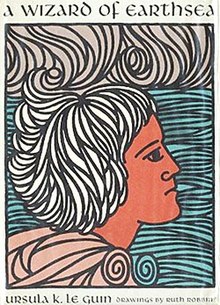
[Book Review] A Wizard of Earthsea (Ursula K. LeGuin, 1968)

AWizardOfEarthsea(1stEd).jpg

The first thing I did upon waking this morning was pick up my recently-purchased copy of Ursula K. Le Guin's A Wizard of Earthsea and eagerly consume the remainder of the book, which I had read last night until I could no longer keep my eyes open.

I was in sixth grade when I first encountered this book in the school library. I changed school districts just after finishing the book, and the new school didn't have the other books in the series, so it gradually fell by the wayside and was forgotten. Until recently, when I saw a copy at the Dawn Treader and remembered really enjoying it the first time around. I'm really glad I bought it when I had the chance, because this book has reminded me of why I fell in love with fantasy in the first place, and its stunning power to enrich our lives with fresh perspective.

I think I may have been too young to really appreciate this book the first time around, because there's a lot going on here that I didn't notice the first time around. I must have completely failed to realize that Ged (a.k.a. Sparrowhawk, the main character) is not a white guy like virtually all fantasy protagonists (his skin tone is described as "red-brown"). I also failed to realize what a big deal that is, especially for a book published in 1968, when (as Le Guin herself said it) "everybody in science fiction had to be a honky named Bob or Joe or Bill."

Sparrowhawk by FreShPAiNt

I also feel like I'm finally old enough to really understand and absorb the lessons which the book teaches about patience, self-knowledge, and the responsibility which comes with great power (I just wish I had taken these lessons more to heart as a young man, rather than insisting on learning them for myself, the hard way). As the Archmage says to Ged after the young man's pride and hubris have left him gravely injured and loosed a terrible evil upon the world:
You thought, as a boy, that a mage is one who can do anything. So I thought, once. So did we all. And the truth is that as a man's real power grows and his knowledge widens, ever the way he can follow grows narrower: until at last he chooses nothing, but does only and wholly what he must do....
I was also captivated by the lovingly-rendered descriptions of sea and surf and sky, of windswept moors and mist-hidden isles, narrow flotsam-choked inlets, great calm bays, and the endless, heaving waterscape of the Open Sea. Le Guin has an anthropologist's eye for culture and and a naturalist's eye for setting, and it makes me appreciate my own landscape (and the lake right behind my new house) all the more fully.

Monday, April 27, 2015

Read Before You Recommend

An Open Letter to TIME Magazine

Dear Editor,

I recently came across an article from your Entertainment section, entitled "Five Fantasy Epics That Would Have Made for Better TV Than Game of Thrones", by Chris Wilson. While I agree with his assessment that the books he recommends would probably do well as high-budget cable TV shows, I'm curious as to how he can make such a recommendation in the first place, since he admits in the article that he hasn't actually read most of the material he's "recommending".

He begins by stating that he never actually finished reading the first installment of George R.R. Martin's A Song of Ice and Fire; in fact, he gave up completely, less than a third of the way into the first book. He's admitted he never read the books, and it's not even clear whether he's watched the show they were adapted into, so how can Mr. Wilson seriously suggest that these other properties would make for better television than Game of Thrones?

When Roger Ebert posted a review of the film Tru Loved without actually finishing it, his readership were so outraged at his lack of professionalism that he was forced to re-watch the entire film, review it again, and issue an apology. I'm not so cruel as to suggest that Mr. Wilson be made to read all of books in all the series he's recommending (since this would likely amount to a life-sentence for the poor man), but he certainly shouldn't be recommending books he hasn't read, and doesn't even seem to respect.

Not only has he not done his research, he also confesses that virtually every series he "recommends" has a dramatic drop-off in quality later on, or that he simply got bored with them after a few volumes. I came away from this article with a strong impression that Mr. Wilson doesn't actually enjoy reading fantasy novels in the first place. In fact, he seems to have nothing but disdain for the genre. Of the eight fantasy series which he mentions by name in his article, he tells us that he never finished reading five of them. Some of them, he never even started reading: he prefaces his recommendation of Robert Jordan's The Wheel of Time by saying "I never actually got into these books".

TV shows cost a lot of money to produce, so if Mr. Wilson is going to recommend a property to be developed into a full-fledged television program, he had better make sure it's a cracking good read, not just something that someone else told him was probably alright.

Why is this guy recommending that people make TV shows out of books he hasn't finished reading, and didn't enjoy in the first place? And more importantly, why are you guys paying him to do it?

Friday, April 1, 2011

Animatronics: Not Dead, Just In Storage

When was the last time you saw a film (besides on DVD or through Netflix!) which boasted of using of "the most advanced animatronics available"? Or indeed, any animatronics at all? A long time ago, I'm willing to bet. Ten years? Maybe more?

To look at it from another angle, when was the last time you saw animatronics used in a real-life, face-to-face setting? Chuck E. Cheese's? Some ride at a theme park for a movie that left theaters fifteen or twenty years ago? Okay, I seem to recall encountering one or two robotic puppets at "The Wizarding World of Harry Potter", but they weren't true animatronics, just models of giant spiders attached to robotic arms.

Animatronics just don't seem to get the same amount of love they once did. The reasons for this are threefold:
1) animatronics are expensive, and once you've made one it's set in stone; you can't do a redesign if the creature doesn't test well with audiences;
2) animatronics contain thousands of moving parts, the malfunction of any one of which could cause the whole machine to cease working, leading to costly delays when filming must be halted while repairs are made; and
3) animatronics are subject to many of the same laws of physics which they attempt to overcome. For example, you can't build a three-story tall praying mantis animatronic for the same reason that a real three-story tall praying mantis wouldn't work: an insect that large simply could not support its own weight.

With these fairly major shortcomings in mind, it's no wonder that filmmakers have turned to CGI to satisfy their needs in the special-effects department.

But I feel that animatronic animals and characters have several advantages over CGI. Advantages which suggest that animatronic technology is not yet dead, nor yet completely outdated.

Number One: Animatronics will always look real.
This one gets swept under the rug a lot. When making a film, the director's primary concern is to get the movie finished on-deadline and under-budget. Everything else is secondary. But what director doesn't want their movies to look good for future audiences, when their films are being displayed by historical societies or film-school professors? The temptation to not just do well, but to leave landmarks for those who follow in one's footsteps is a powerful desire in many directors.

For proof, one simply needs to look at Star Wars.

Pop a copy of Episode I into your DVD player, and take a good look at Jar-Jar Binks. (I know it hurts. Just bear with me for a moment.) Look at how he moves, how he interacts with the objects and actors around him. It doesn't quite look right, does it? Kinda... floaty, right? Like he's not really there? Jar-Jar was created just twelve years ago, using the most advanced CGI technology that had ever been assembled at that time. Barely a decade has passed, and he already looks fake.

Okay, now eject the disk, invite a priest over to purify your entertainment system, and pop in your DVD of Star Wars: A New Hope. Take a good hard look at Chewbacca. He looks really solid, doesn't he? He makes fluid motions, casts realistic shadow-effects, and has a palpable stage-presence. That movie is twenty years older than Episode I, yet Chewie still looks more realistic than Jar-Jar ever could. Why is this? It's because Chewbacca was actually there on the set! Which brings me to my next point,

Number Two: Animatronics have superior stage-presence to purely-CGI characters.


When a CGI character interacts with a flesh-and-blood actor, in almost every case the actor was playing to an empty room, or a blank green-screen. As any actor will tell you, playing a part, any part at all, without another human presence to judge by and interact with, is an extremely difficult endeavor. Even if there was a man in a skintight greensuit standing where the monster's going to be in the final version, it's not the same as actually having the monster standing right in front of you, roaring and spitting venom in your face.

Number Three: Animatronic characters have a warmer, more human appearance.
Even if the character in question is not human at all, animatronics often induce much greater feelings of affection in audiences than any CGI character. Because the machines are bound by the same laws of physics as we are, their motions, by definition, look real and natural. While animators are busy trying to figure out how to convey a sense of weight and solidity in their creations, all a puppeteer needs to do is hit the "ON" switch and play around for a few minutes.


Furthermore, the fact that a puppeteer (or team of puppeteers) controls the machine's every motion means that all their motions will be infinitely more human. The animators don't need to search for the key to simulating natural movement; it's sitting right in front of them, waggling its ears and making faces at them.