Friday, August 28, 2020

[Book Review] How to Do Nothing: Resisting the Attention Economy, by Jenny Odell

How to Do Nothing: Resisting the Attention Economy, Odell, Jenny -  Amazon.com

Hardcover, 240 pagesPublished April 9th 2019 by Melville House

This book started out strong, then sagged in the middle, but it was alright in the end.

As someone who has recently gotten off Facebook (hopefully forever), I identified strongly with the author's thesis that there are many pressures in our hyperconnected modern lives which conspire to rob us of the ability to think before we act (or speak, or post). Social media hijacks our brains by showering us with dopamine when we churn out timely, pithy one-liners that get tons of 'likes' at the cost of ignoring nuance, paradox, and respect for those with whom we are debating. As each individual is rewarded for chipping away at the ties which bind our society together, it should surprise no one that our society feels more divided than ever.

Unfortunately, I think the average American reader will have a lot of difficulty identifying with the middle portion of How to Do Nothing, especially as Odell trots out the works of various poets, painters, photographers, and performance artists to make her point. I expect that one long passage where she analyzes the philosophy of the Greek philosopher Diogenes through the lens of performance art will be an exit-point for many readers. The overall effect is one of pretentiousness and self-indulgence; readers from non-coastal or blue collar backgrounds will have a hard time caring about the civil disobedience (read: shiftless, lazy entitlement) of Herman Melville's "Bartleby, the Scrivener". I could almost *hear* the audience laughing at the author's oblivious, tone-deaf attempts to explain to readers why they should attend live performances of John Cage's 4'33", or watch bizarre and plotless foreign art-films like 2011's The Exchange.

But towards the end, the book regained some of its earlier lost momentum. Once Odell gets off her high horse and starts talking about practical stuff that the average American can relate to (meeting your neighbors, understanding your bioregion and your place within it, replacing the endlessly-scrolling newsfeed with a focus on personal relationships and context), the book became a lot more interesting. I honestly think it contains a lot of good ideas, and it could deliver a lot of benefit to anyone who is uncomfortable with their own relationship to technology and social media.

How to Do Nothing is not so much a how-to guide as a philosophical treatise; which I suppose is important after all, and increasingly rare in this constantly-accelerating and increasingly-optimized world of ours. Sometimes it's important to be bored, to sit with that feeling, and to ask yourself why you're in so much of a damn hurry anyway.

Sunday, July 26, 2020

[Book Review] Grimm's Fairy Tales

35047520


Grimm's Fairy Tales Illustrated Collection: Edited by Frances Jenkins Olcott with Illustrations by Rie Cramer, by Jacob and Wilhelm Grimm 
1922, The Hampton Publishing Company, New York

It's interesting to come back to these old familiar tales, half-remembered from childhood, and approach them with the life-experiences and critical reading skills of an adult. Stories which once seemed nonsensical, even frustrating, now yield positive messages of loyalty, perseverance, charity, and hope... when approached with an open mind and a willingness to think deeply.

Like a puzzling koan, these folktales are an open invitation for the reader to ask oneself "What can I learn from this? What life-lesson is the storyteller trying to pass on?" Instead of getting bogged down in the sexism, materialism, and gruesome violence (of which there is no shortage), I found that I was able to see a deeper meaning, a message which whispers fear not, it will all work out in the end somehow.

Tolkien writes of the "eucatastrophe", the opposite of a catastrophe, the happy ending where everything turns out alright: despite their evil magic and malicious lies, somehow the schemes of the wicked come to naught and the True Bride unveils herself to her true love the Prince; despite being cruelly killed by his elder brothers, our hero is brought back to life by his friends and rides to the rescue on a white steed; the tale which began with poverty and abuse ends in wealth and love and happiness. Sometimes, yes, happy endings can seem contrived, even saccharine or schmaltzy. But there are times when we really, desperately need to hear someone tell us that happy endings are possible, even in the grimmest of circumstances. And the Brothers Grimm deliver these eucatastrophes in abundance.

However, there are a few tales in the mix that simply don't stand the test of time. "King Thrushbeard" gaslights his new bride in order to "break her" of her haughtiness and rude behavior towards her many suitors. "Clever Hans" is annoyingly repetitive, incongruously violent, and somehow Hans is rewarded in the end with marriage to his sweetheart despite showering her in the freshly gouged-out eyes of livestock (yes, really). "Little Brother and Little Sister", in addition to having a very uncreative title, seems like one long shaggy dog story that, despite featuring animal transformations, a murder, and a resurrection, meanders without direction and only produces a happy ending as the result of (if you'll pardon the technical term) a complete ass-pull. Even several of the really excellent stories — "The Nixie of the Mill-Pond", "The Six Swans", "Mother Holle", "The Two Travelers" — could benefit from a good editor.

Overall, Grimm's Fairy Tales might be better-suited to an adult audience than a young one; young children may find the archaic language difficult to follow, and adults will be hard-pressed to answer their inevitable questions about why certain characters choose to be so mindlessly cruel, so naively trusting, or to do the thing that they've been explicitly warned not to do on two previous occasions. Still, if approached with an open mind and a childlike sense of wonder, these classic tales do have deep, mythic lessons to teach us... lessons that can still resonate in the hearts modern readers of all ages.

Sunday, April 26, 2020

Moby-Dick; or, The Whale


I've been meaning to read this book for years. Three of my favorite authors (Nicholas Meyer of the even-numbered Star Trek movies, Mike Carey of The Unwritten, and science fiction juggernaut Ray Bradbury) have repeatedly expressed deep admiration for Herman Melville's 1851 novel, making extensive allusions to it in their own works. Heck, Bradbury loved it so much that he wrote the screenplay for the 1956 movie starring Gregory Peck as Captain Ahab! To endure as a "classic" for a hundred and fifty years and amass a fan-club that includes writers like those three, Melville must've done something right, right?

Boy, did he ever.

Moby-Dick is (if you'll pardon the obvious pun) a whale of a tale. And I mean that literally: it's a huge book, almost a thousand pages long. And it's not only whale-like in size, but in depth as well, sounding  the human soul and the human condition in ways that most other novels can only weakly imitate, covering themes as diverse as friendship, work, man's relationship with the natural world, madness, revenge, fate and destiny, human frailty, mortality, and about a hundred other themes besides.

I'll warn you before I go much farther, though: this book isn't for everyone. Obviously, if you have a problem with graphic depictions of animal harm, then this isn't the book for you; there are passages where the main characters are literally drenched in the blood of their prey, and Melville gets explicit when describing how they take the whales apart, winnowing these leviathans down into oil and meat and ivory. Likewise if you need female characters to catch your interest: there are only two minor female characters in the whole novel, and none appear after the Pequod sets sail. This is realistic for the setting, since women, as a rule, did not travel on whaling ships, but it's worth mentioning that the entire cast is basically one big sausage-fest.

That said, I think that this book will give you a lot of food for thought, if you give it a chance. I was struck early-on by how funny the narrator, Ishmael, can be when he turns his keen wit on his fellow men; he wryly remarks, upon being forced to share a bed with a Polynesian cannibal (who later becomes his best friend): "Better a sober cannibal than a drunken Christian." As a former schoolmaster, Ishmael is well versed in classical literature, European and American history, geography, the natural sciences, and even scriptural analysis. His web of allusions and references is so dense that any worthwhile edition will include endnotes for clarity's sake.

Moby-Dick is also surprisingly exciting, which I really didn't expect in a book that was written before the Civil War. There were several times where I needed to stop reading and consciously relax the muscles in my legs and arms, because I had tensed up with fear and anticipation. There were harrowing, horrifying scenes where I gasped aloud as men were killed, or maimed, or drowned, or dragged off into the deep blue sea. Melville does a great job of conveying how incredibly, insanely dangerous the whaling profession was. In an age without radios or flare-guns or life vests, these men piled into rowboats, six at a time, to chase down, harass, stab, and enrage animals who could weigh more than sixty tons! And if that's not enough, after fastening themselves to the whale with a giant meat-hook and being dragged behind it for miles, praying that their boat didn't swamp and the leviathan didn't decide to go for a deep dive. And all this they did with the whale-line, the rope which attached whale and harpoon to boat and crew, twisted around their necks and oars! Ishmael observes that "when the line is darting out, to be seated then in the boat, is like being seated in the midst of the manifold whizzings of a steam-engine in full play, when every flying beam, and shaft, and wheel, is grazing you."

Speaking of whaling equipment, the edition I read has some really gorgeous Early American Modernist illustrations by Rockwell Kent, which helped to clarify and explain a lot of the obscure terminology and nautical tools to which Melville alludes. For someone like me who has never been to sea, I found Kent's illustrations really helped convey the sheer sense of size, the breathtaking power of whales and the sea in which they live. If you get a chance, I recommend an illustrated edition if you can find one.

Strange to say, I can't honestly believe that Melville/Ishmael is entirely at peace with his profession, with the business of hunting and killing whales. Not after reading Chapter 87: The Grand Armada. I don't know how you could write such a tender, touching encounter between whalemen and their prey and not be affected by it somehow. I think this passage helps to underscore the key differences between Ishmael and his captain, Ahab:
''And thus, though surrounded by circle upon circle of consternations and affrights, did these inscrutable creatures at the centre [of the herd] freely and fearlessly indulge in all peaceful concernments; yea, serenely revelled in dalliance and delight. But even so, amid the tornadoed Atlantic of my being, do I myself still for ever centrally disport in mute calm; and while ponderous planets of unwaning woe revolve round me, deep down and deep inland there I still bathe me in eternal mildness of joy.''
I take this to mean that Ishmael gives himself a little space, in the very heart of his being, where he doesn't let the world get to him, and can appreciate the beautiful things in life, in the sea, in his quotidian workaday life, and even in the whales he hunts. Ahab, on the other hand, can only see whales as embodiments of evil, living incarnations of "some unknown but still reasoning thing [that] puts forth the mouldings of its features from behind the unreasoning mask." Both men project their own inner natures onto their prey: one sees gentle creatures with complex lives and life cycles, the other sees only mindless brutes that exist only to torment and destroy mortal men.


...which leads me neatly to Captain Ahab himself. I saved him for the end because, asides from Moby Dick himself, Ahab is probably the most enigmatic character in the book. His name is practically synonymous with madness and doomed quests, but his arguments are weirdly compelling anyway. He's able to command the loyalty of his crew through a combination of personal magnetism, revenge fantasy, pseudo-religious symbolism, and appealing to the base human desire for violence and victory. Scholars have spilled oceans of ink on the subject of Ahab alone, so there's no chance that I'll really do him justice in these few-hundred words. Personally, I wonder if his mad quest for the White Whale really is the revenge-fantasy that most readers make it out to be. I wonder if, deep in his heart of hearts, Ahab knows this is a battle he can't hope to win. I wonder if his doomed quest for the beast that maimed him is really a form of suicide-by-whale.

Over the last century and a half, critics have claimed that the White Whale himself represents many things: God-with-a-capital-G, or Evil-with-a-capital-E, or the unstoppable and uncompromising power of Nature, or death/mortality, or the unfairness of life, or the ocean itself; the list goes on and on. Each critic seems to see something different in the White Whale's wrinkled brow and snow-white skin. Melville/Ishmael declines to define the White Whale too closely, preferring to let us use our own imaginations to discover what we see in him. Like an enormous movie-screen, we can project anything we want onto Moby-Dick's snowy flesh, but all of our assertions and projections only bounce off his chalky skin, leaving his insides, his true nature, untouched and unknowable.

Thursday, May 23, 2019

[Book Review] Wings of a Flying Tiger, by Iris Yang

Wings of a Flying Tiger by Iris Yang

Title: Wings of a Flying Tiger
Author: Iris Yang (Qing Yang)
Publisher: Open Books
Publication Date: 06 September 2018

Even though it's fiction, this book is brutal. Many first-time authors tend to mollycoddle their characters; although it's clear she loves her characters dearly, Iris Yang is not one of those authors. It's rare to find a writer who intersperses moments of loving tenderness and peaceful village life with horrific scenes of bloody warfare, mass execution, and rape, and does it in a way that makes narrative sense and feels believable. But somehow, Iris Yang makes the whole story come together in a tapestry of war, heroism, violence, love, life, and death.

Very early on, it becomes clear that this story will be less about narrow escapes and more about how humans carry on even after the worst has happened. Plans go wrong, hopes are dashed, and minor characters die by the truckload. But through it all, there is a spirit of perseverance, a sense of the importance of holding onto life and hope despite overwhelming odds, if only to make oneself that much harder for the enemy to kill. This nameless characteristic seems uniquely Chinese to me; it's probably what allowed them to survive the war and the Japanese occupation, and all that came after it.

The very first character we meet is Danny Hardy, a fighter pilot of the First American Volunteer Group (AVG) of the Chinese Air Force (nicknamed "the Flying Tigers"), but we don't really get to know him until Act 2. The story mainly follows Jasmine Bai, the educated daughter of two professors at Nanking University, on the eve of the infamous Rape of Nanking by Japanese soldiers. From the moment Jasmine gets off the train, it's clear that China's wartime capitol is in desperate shape: her car is immediately swamped with refugees going the other way, and Jasmine has to crawl through a window to get out. From that moment on, everything that can go wrong, does. Japanese soldiers sack the city, using Chinese POWs for bayonet practice and brutally raping every young Chinese woman or girl they can lay their hands on. The city is a bloodbath, and only through a combination of luck and brave protectors does Jasmine make it out alive. She and her teenage cousin Daisy Bai are sent to a tiny mountain village in southwestern Yunnan Province for their own protection, and it is there that the two young women save the life of the aforementioned pilot Danny Hardy. Their decision to heal his wounds and hide him from Japanese soldiers will have terrible consequences for the young women, and for the villagers who harbor them.

If you're looking for an interesting perspective on an aspect of World War II and Chinese-American relations that is rarely discussed in this era of rising tensions between the two superpowers, then Wings of a Flying Tiger will take you on a wrenching-but-powerful emotional journey. I can't wait to read the sequel!

Friday, April 12, 2019

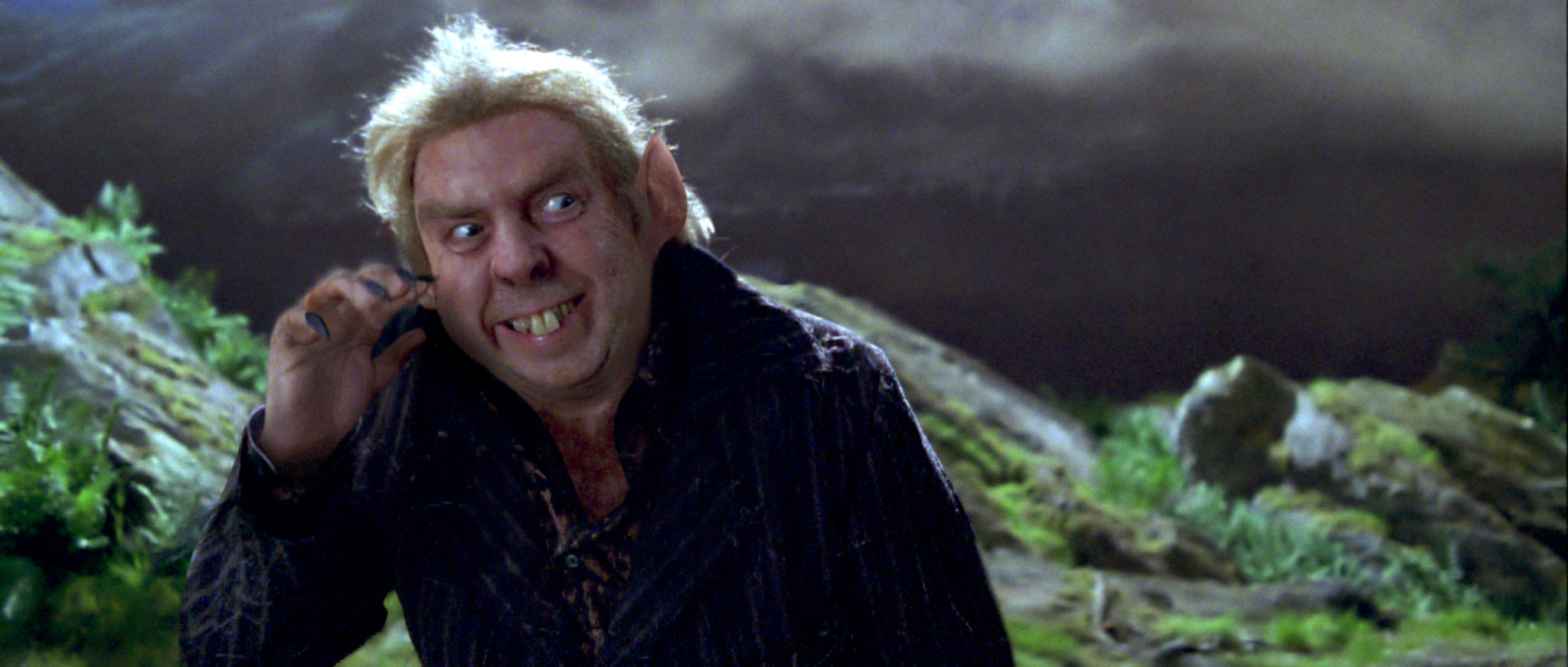
A Dot Labelled "Peter Pettigrew"


(SPOILER WARNING: Obviously, this post contains spoilers for Harry Potter and the Prisoner of Azkaban, and basically all other books/films in the Harry Potter franchise.)

Okay wizards and witches, it's fan-theory time. Today we're addressing that age-old continuity conundrum, "Why didn't Fred and George Weasley notice in their Marauder's Map that there was a little dot labelled 'Peter Pettigrew' following their little brother around and sleeping in his bed?" Fear not, Gentle Readers: I propose a solution which may explain not only this, but other apparent continuity errors as well.

The reason Fred and George never noticed that the little dot labelled "Peter Pettigrew" in Ron's bed is because Peter Pettigrew was not his name at that time.

Image result for peter pettigrew
How did that sleazy little creep get Sorted into Gryffindor, though?
After living as a rat for twelve years, Pettigrew was Scabbers for all intents and purposes. No one had called him anything but Scabbers in more than a decade, and as far as we know he had never, in all that time, broken character . It makes sense that he would have come to inhabit the role completely, thinking of himself as Scabbers (if he thought of himself at all, and didn't simply go on autopilot and let his rat instincts take over). But when news of Sirius' escape from Azkaban reached him, something shifted in his little rodent mind, and he began to remember the reason he had been living as a rat for all those years. The guilt came rushing back, and so perforce did the memories of what he had done, why he had hidden for so long.

According to the Marauder's Map Fact File on Pottermore, the Marauder's Map "[s]hows the location of any person or ghost on Hogwarts' grounds, [and] isn’t fooled by an Animagus or an Invisibility Cloak." It says nothing about animals or non-sentient beings, and given that Harry never specifically mentions seeing anything other then humans and ghosts in the map, it's reasonable to assume that the map only shows sentient beings. This makes sense from a user experience standpoint. Think about it: if the map showed every organism in Hogwarts, the interface would be overloaded with useless information about the position of every mouse, spider, and fruit-fly in the castle, making it much more difficult for the user to filter out the important information.

If the above is true (and I'll admit, that's a big "if"), then that also explains why Fred and George never noticed a long thin shape labelled "Slytherin's Monster" slithering through the walls during Chamber of Secrets. Being a non-sentient creature without a unique name that it was aware of, the basilisk thus did not show up on the Marauder's Map.

Image result for peter pettigrew marauder's map

This theory also supported by the movie-only scene in Alfonso Cuaron's Harry Potter and the Prisoner of Azkaban, in which Harry sees a dot labelled "Peter Pettigrew" in the Marauder's Map which is moving towards him down a dark and (apparently empty) hallway. Harry never actually sees Pettigrew on the map in the book, but if we take this scene as canon, it suggests that by this point Pettigrew had started to remember who he was, and the map re-labelled him accordingly.

Now don't worry, I can hear your objections already. "But why didn't the map say 'Helena Ravenclaw' instead of 'The Grey Lady'? Why didn't it show Voldemort standing next to Quirrel?" Both excellent questions, Astute Reader. I shall endeavor to answer them as best I can. First, Helena Ravenclaw did not show up on the map for precisely the reasons mentioned in my theory: she had been known as the "Grey Lady" for so long (nearly a thousand years) that she had internalized the name and considered it her own.

As for Voldemort, I can't say for sure. If the map shows ghosts, then one could reasonably assume that the Dark Lord would show up as well, right? Not necessarily. When Voldemort returns to life near the end of Goblet of Fire, he says to his Death Eaters that when the spell he intended to kill Harry with rebounded, "I was ripped from my body, less than spirit, less than the meanest ghost … but still, I was alive. What I was, even I do not know … "

Whatever was left of Voldemort may have been too little for the map to recognize as sentient, or it may have been masked by Quirrel's life-force. Finally, (and this may be a bit of a stretch), Voldemort is often known as "He-Who-Must-Not-Be-Named", so maybe his name itself was under some sort of concealing enchantment which makes it not show up on all but the most powerful detection systems, sort of like the nominal equivalent of being Unplottable? We know that he has the power to make his name Taboo, so making it Unplottable as well doesn't seem like too much of a stretch.

Though the above theory is obviously not canon, I hope that it can help to clear up any issues you may have had with the illustrious Ms. Rowling's storytelling.

Until next time... mischief managed.


Tuesday, March 26, 2019

[Book Review] The Year of Less, by Cait Flanders


The Year of Less: How I Stopped Shopping, Gave Away My Belongings, and Discovered Life is Worth More Than Anything You Can Buy in a Store
Author: Cait Flanders
Recording Artist: Cait Flanders
Publisher: Tantor Media
Year: 2017

I think it's fair to say that, for most people living in the so-called First World, the idea of going an entire year without purchasing anything but food and essentials is a pretty terrifying prospect. You're probably already tensed up just thinking about it. Not buying anything? No lattes to-go, no new video games or DVDs, no new outfits or tickets to movies or anything at all?! How would we live? What would we do? How could we survive the howling maelstrom of sensation that is the Internet Age without the ability to spend our hard-earned cash on the things that matter most to us, the things which give our lives so much fulfillment?

Well, that's just the issue, isn't it? What does matter most to us? Do our possessions bring us fulfillment? Do we even remember all the junk we've spent that hard-earned cash on? Lots of people run themselves ragged working jobs they hate so they can pay their bills every month, but are we paying for things that make us truly happy and secure? Or are we just flinging dollars away to keep the twin specters of Boredom and Silence at bay, like a cornered man hurling sausage-links at an approaching pack of wild dogs?

By her early twenties, Cait Flanders was (like many Americans and Canadians), up to her eyeballs in debt. More than $30,000 of debt, and almost all of it racked up to pay for things, possessions, physical objects which brought her no joy but she couldn't bear to get part with because she had spent so much on them already, and besides, someday she might use them! Add to this her binge-eating and compulsive blackout drinking (which started at age 12), and you've got one very unlikely candidate for future financial- and lifestyle-guru. But become a guru she did! This book chronicles how that came about.

Cait started blogging about her efforts to pay off her consumer debt as a way to keep herself accountable. Publicly sharing her budget and what she spent her money on forced her to stick to her principles and continually reach for her goals, or else face the unpleasant task of explaining to her readers why she had fallen short that month. Slowly, over the course of two years, she paid off her debt and built up a sizable online following. But she discovered that as soon as the debt was gone, the old habits came roaring back. She began to ask herself:
"If I was only saving up to 10 percent of my income, where was the rest of my money going? Why was I continually making excuses for my spending? Did I really need 90 percent of my income or could I live on less?"
Cait decided to find out, in the only way she knew how: by leaping in with both feet. She decided to challenge herself to give up shopping for an entire year, only allowing herself to buy the essentials: food, toiletries, gasoline, electricity, and other essential consumables. Among other things, she had a rule that she could only replace things that wore out or broke if both of the following applied: A) the item was absolutely essential and caused her a daily inconvenience to go without it, and B) she threw out, donated, or otherwise got rid of the original item she was replacing. Armed with a sense of purpose and spurred on by the fear of public shaming (she had told everyone she knew about her plan, so she wouldn't chicken out), Cait launched into a yearlong Shopping Ban.

Not only did Cait swear to go a year without shopping, she also decided to take stock of every item she owned and publish the inventory on her blog. Years before Marie Kondo was a phenomenon, Cait decided she'd had enough and ultimately gave away more than half of her possessions, on top of her Shopping Ban!

As the year wore on, Cait began to notice disturbing similarities in the way she related to her three vices: food, alcohol, and shopping. Although I've never had a serious problem with alcohol, shopping, or overeating, I still found that much of what she was saying resonated with me. For much of our twenties, my wife and I spent everything we earned on fancy dinners out, having adventures with friends, sweet treats and cups of overpriced coffee, and purchasing whatever passing fancy caught our attention for more than a moment. We were having fun, sure, but spending all that money was really just keeping us from achieving our goals, like owning a house or traveling.

Although we had already paid off the all of our remaining debt more than a year before encountering Ms. Flanders' book, The Year of Less has helped to reinforce and galvanize us in our decision to live frugally, to save as much as possible, and to not waste our money on anything that isn't getting us closer to checking items off our bucket-list. It's a difficult decision to make in a world where anything you want can be yours in seconds (and with free shipping if you spend just a few dollars more), but as Cait Flanders proves, it can be done.

And who knows? Maybe, like her, you'll find that you're happier with less than you ever were with more.

Wednesday, July 25, 2018

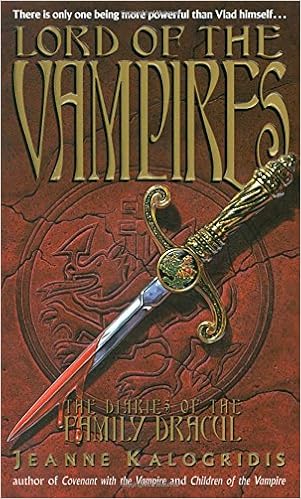
[Book Review] Lord of the Vampires

Image result for lord of the vampires jeanne kalogridis

Lord of the Vampires, by Jeanne Kalogridis
(The Diaries of the Family Dracul, Book Three)
© 1996 Dell Publishing

Jeanne Kalogridis' capstone to her Diaries trilogy takes place concurrently with the events of Bram Stoker's Dracula. In fact, Lord of the Vampires offers an entirely new take on many of the events of that famed seminal novel of vampire fiction, providing more than just new insights on Stoker's existing canon, but entirely new, previously-unseen aspects, characters, and plot-points.

Well, perhaps "entirely new" is a bit of an overstatement. Kalogridis never adds completely new characters out of whole cloth; she has too much respect for Stoker to do that. Instead, she dramatically expands on what were previously unnamed background characters -- such as Dracula's three "brides" or Van Helsing's mysterious friend Arminius -- fleshing them out into fully-rounded characters with their own psychologies, motivations, and story arcs. As a result, we see Dracula, which was already a novel of many viewpoints, from the points of view of new characters, or from the same characters but with new information: for instance, we learn that Dr, Seward's wax cylinder dictations, which comprise his contributions to the original novel, only told part of what he knew. Here, Kalogridis makes us privy to his private, hand-written journals, which reveal that he (and his mentor, Prof. Van Helsing), know considerably more about vampirism in general and Vlad Dracul in particular, than the original novel suggested.

Related image
Professor Abraham Van Helsing, MD, D.Ph., D.Litt., etc, etc.
Speaking of whom, Van Helsing is present for many more of the events of Dracula than we had previously been led to believe. As a result of the hypnotic and mystical powers which he acquired under the tutelage of the mysterious sage Arminius in the previous novel, Van Helsing is able to render himself invisible to (most) mortal eyes, allowing him to play an unseen part in many scenes for which he was not present in Stoker's novel, such as the scene where Dracula kills Lucy and her mother. Usually these kinds of changes only result in minor, cosmetic differences to the scenes, but sometimes his presence (or the presence of other, similarly-invisible beings) casts old scenes in a completely different light. Which is important, because the author is working within a tight framework of restrictions.

By writing a novel that takes place within the events and context of another novel -- and an extremely famous one at that -- Kalogridis has taken on the difficult task of trying to surprise her readers while telling them a story they've heard many times before, without changing too much of the story or introducing elements which break her audience's suspension of disbelief. If she adheres to Stoker's plot too slavishly, the audience will get bored; if she changes things too much, they'll get angry and defensive. Fortunately, Kalogridis manages to strike a delicate balance between old and new, crafting a tale which manages to bring us back to familiar ground while simultaneously making it seem new and exciting.

Lord of the Vampires introduces something new to the series: a sense of pathos, of real human suffering. Not just supernatural cruelty (though there is plenty of that), but a peek into the houses of the dying. Early on we learn that Van Helsing's mother, Mary Windham-Tepesh, is dying of cancer, and we see in intimate detail just how devoted her son is to caring for her through even the most piteously gruesome aspects of late-stage cancer. Much attention is lovingly paid to the mood in the Westenra household as Lucy lies dying: we see the heartache and the pain which it brings, but as Van Helsing observes: "in the midst of gloom shines a ray of love and valour. . . . the experience [of caring for a mortally ill family member] melts away the more superficial aspects of the personality, revealing a golden core of strength and compassion."


Image result for elizabeth bathory
Pictured: One bad mofo
This, of course, is in stark contrast to the glamorous beauty and shocking depravity of the newest major character in the series, one Elizabeth Báthory, the infamous "Blood Countess" who (allegedly) tortured more than six hundred female servants over a period of decades and bathed in their blood to maintain her own beauty (consider yourselves trigger-warned for torture scenes and lesbian blood-orgies). Elizabeth shows up at Vlad's invitation to Castle Dracula, where she promptly restores both his and Zsuzsanna's youth and vigor (they having been trapped within Castle Dracula for the last twenty years, since the end of the previous book) and then gets screwed over by Vlad as he abandons them with only poor little Jonathan Harker as their last meal, who promptly escapes. Zsuzsanna and Elizabeth, seeking their revenge on Vlad, break out of Castle Dracula and pursue their erstwhile benefactor to England, where they work together in secret to destroy him (and their hated foe, the vampire-hunter Van Helsing).

In some ways, Lord of the Vampires is like those episodes of Game of Thrones that diverge from the books they're based on: what seemed predictable is suddenly no longer following the path which we expected, and this creates cognitive dissonance and dramatic tension. What was once familiar is suddenly, disconcertingly unfamiliar. Although it's sometimes a little maddening to see Van Helsing or Zsuzsanna being secretly present in familiar scenes yet unwilling to do anything to change their outcomes (for reasons which seem flimsy at best), Lord of the Vampires is overall an interesting second-take on a very well-known story, which forces us to pause and reconsider whether we actually know it all that well (or whether we know the whole truth of it). Many have commented about the logical inconsistencies of Dracula ( the vampire's inconsistent powers and weaknesses, his abysmal impulse-control, Van Helsing's shocking willingness to leave Mina undefended and ignorant of the truth), and this book does go a long way towards explaining some of these decisions, as well as providing more insight into the psychology and motivations of one of literature's greatest villains.

Friday, May 11, 2018

[Book Review] The Arsonist

Image result for the arsonist
The Arsonist, by Stephanie Oakes
© 2017 Penguin Random House

This one sat on our bookshelf for almost a year before my wife read it, but as soon as she finished she got me to read it, and now I'm kicking myself for not reading it sooner. More than once I live-texted my wife as I read, keeping her up-to-date on which jaw-dropping reversal of fortune I had just witnessed. The Arsonist has twists and turns, game-changing revelations and appalling betrayals, each one following close on the heels of another. At first, the bizarre cover art turned me off (though full disclosure: I read an advance copy, so the cover art and text of your version might be different), but once I started reading I quickly found the main characters engrossing. The Arsonist has three protagonists, all teenagers: epic-level weirdo and social pariah Molly Mavity, seizure-prone Kuwaiti immigrant Ibrahim "Pepper" Al-Yusef, and . . . well, the third protagonist is complicated.

The third protagonist is Ava Dreyman, and we mostly learn about her through her posthumously-published 1989 diary, which details her escape from East Germany in the mid-80s, followed by her return to rescue her mother, and her (apparent?) death at the hands of a high-ranking Stasi officer. But as Molly and Pepper delve deeper into the mystery of Ava's death—which intertwines with the secrets kept from both of them by their respective parents—they are forced to question not only Ava's story, but the narratives which they've both built up to define their own lives and identities.

Image result for Fernsehturm
Fernsehturm, Berlin
The Arsonist is marketed in the "Teen & Young Adult Mystery & Suspense" category (among others), but I feel that this sells the story somewhat short. While aimed at teenagers, this novel could easily find a welcome audience among adults. Arguably, adults who remember the Cold War might actually get more out of this story than its intended audience can. It's one thing to learn about the Cold War in history class, but it's very different if you actually lived through it. Personally, I was old enough to be vaguely familiar with the word "NATO" and know that it was on the news a lot, but since Berlin Wall came down when I had barely entered preschool, the Iron Curtain always seemed to me more like an artifact of the past than something that was briefly my contemporary. So for me, I feel I came away with a greater appreciation for events which took place during my own lifetime.

Oakes' gripping prose ricochets from viewpoint to viewpoint, rotating with blinding speed between Molly, Pepper, and excerpts from Ava's diary: which, in this fictional universe, is a large part of the reason the Berlin Wall came down in the first place. The shocking tale of Ava's state-sanctioned torture and death galvanized the downtrodden East German public and helped give them the courage to stand up to their monstrous rulers and its vast network of spies and informants; a sort of East German Anne Frank, if you will. But hero-worship makes us blind to realities we would often rather forget, or wish we had never known: as Captain Mal once said, "every man ever got a statue made of him was one kind of sumbitch or another." Turns out that little chestnut applies to teenage girls, too (though I won't say exactly how).

Image result for Berlin's Palace of the Republic
The Palast der Republik, East Berlin
The Arsonist is also a poignant examination of loss, and the ways in which we heal, sometimes without realizing it, from wounds which we felt sure must kill us. All the characters in this book (and especially the three protagonists) are dealing with loss in one way or another, and the protagonists all have dead parents in their pasts. For Pepper, it's his mother, who died while giving birth to him in the shadow of a burning oil field during Operation Desert Storm. For Molly it's her mother, whom the rest of the world believes committed suicide three years ago, but whom Molly still insists upon believing is alive and in hiding for unknown reasons. And Ava... well, I won't spoil it for you, but let it never be said that writing, printing, and distributing a subversive newsletter and burning down Stasi administration buildings is an occupation that's free from risk.

Overall, I give The Arsonist the very highest marks, even in its unedited pre-publication form. Switching with ease between the hilarious and the horrifying, between snappy dialogue and heart-wrenching examinations of grief, adolescence, parenthood, and trauma and healing (both emotional and physical), The Arsonist is an adrenaline-fueled thrill ride that somehow finds time to sneak in an emotional sucker-punch or two when you're least expecting them.

Friday, March 9, 2018

[Book Review] Children of the Vampire

Image result for children of the vampire

Children of the Vampire, by Jeanne Kalogridis
(The Diaries of the Family Dracul, Book Two)
© 1995 Delacorte Press

After finishing the the first book in this series, the deliciously-disgusting and deeply disturbing Covenant with the Vampire, I was eager and excited to dive into this sequel, which picks up mere hours after the first entry left off. Unfortunately, despite a very strong opening and a taut overall construction, I found that my eagerness for more information on the origins and nature of the infamous Count Dracula was hampered by lopsided dramatic structure, and the introduction of several new elements which I personally find incongruous with the Dracula mythos, and with vampires in general.

[Obviously, this being the second in a series, reviewing Children of the Vampire will entail spoilers for the ending and major plot developments of the previous book, Covenant with the Vampire. Consider yourself forewarned and forearmed.]

Children begins with an excerpt from Covenant: two diary entries which explain Vlad Dracul's origin as strigoi, the true natures of his no-less-than three secret covenants — one with the townsfolk who provide him with victims, one with the eldest male of his mortal descendants who disposes of his victims' bodies to prevent them from rising as undead, and one with the Devil himself (the details of which are as-yet unknown). As Arkady's (now-undead) sister Zsuzsanna explains, "The soul of the eldest surviving son of each Tsepesh generation: that is the gold with which he purchases his immortality." 


As I've stated previously, the opening of Children is highly compelling, beginning with a description of Arkady's first, doomed attempt to slay the monster who made him one of the undead at the end of the previous installment. This is honestly one of the finest bits of exposition I've ever read, and it beautifully illustrates the ungodly strength against which Arkady has arrayed himself. I'm going to quote at length from this passage, because it's just. That. Damn. Good.
          I leapt at him with the stake, aiming to plunge deep it into his chest. As I did so, he stepped aside with supernatural speed and graceand caught the hand that held the stake, with such might that my arm was pulled from its socket.
          I howled, tried to wrest free, but his strength outmatched mine tenfold; with a brutal yank, he tore the arm from me, leaving my shoulder a stump that spewed my latest victim's blood. As I watched, stunned, he tossed it
the fingers still clutching the stakewith casual grace into the fire.
          But I too was no longer mortal; so, neither, was my wound. The pain blinded for one brief brilliant instant, then transformed into pure energizing rage. Again I charged
this time knocking V. into the flames.
          As he struggled to rise, hair and waistcoat ablaze, I retrieved my severed limb
only to realise, with amazement, that another had instantaneously and completely regrown to take its place. I snatched the charred stake from my erstwhile fingers and, oblivious to its blistering heat, rushed with it at V.
          To my surprise, he spread his arms in welcome, a smouldering, willing target that wore the Devil's own grin. I struck out with every shred of my newfound immortal strength, determined to drive the stake clear through his cold heart; struck out again. Again. Again.
          The stake would not pierce him.
          Like a madman, I flailed at him with it
but it was as though the very air itself formed an impenetrable cushion above his chest. I hammered away until the wood itself began to splinter. All the while, he laughed, soft and low, with the condescension of an adult watching a helplessly furious child; but them his amusement faded and turned to murderous fury.
I know, right?

After his abortive attempt on Vlad's (un)life, Arkady lays low in Vienna for a while, until he gets a visit from his dear old sister Zsuzsanna, who shows up with two drunken victims as a peace-offering. She instructs her brother in the subtle art of seduction, but the scene turns horrific when Arkady realizes that she's used her vampiric mesmerism (and the heady rush from feeding off a pair of wine-sops) to trick him into having drunken sex with her, his own sister! 

b
EEEEEUUUUUGHHHH!
After this abrupt splash of cold water on what had been an entertaining scene which walked the fine line between horror and voyeurism, we're told that Zsuza transgressed this most ancient of boundaries in the hopes of conceiving a dhampir: apparently in this mythos (and real-world Slavic folklore), vampires retain the ability to reproduce during their first year after being turned. This seems like a big change to the generally-accepted rules of vampirism, but I was willing to let it slide if the author could to something interesting with it. Unfortunately, she never does. That's right, Ms. Kalogridis just blue-balls her readers purely to fuck with us, because nothing ever comes of this development! Zsuza does not conceive, and asides from establishing that she really regrets never having children of her own while she was alive, the whole incest shocker contributes nothing to the overall plot! The author could have just had Zsuzsa say "I really regret not having kids while I was alive", she didn't have to set us up with erotic expectation and then shove a steaming platter of incest in our faces!

I mean really, who does that to their readers?

Anyway, Zsuzsa tells Arkady he's not strong enough to challenge Vlad (duh), but he can get stronger by training at the Scholomance, a school for the black arts that's hidden somewhere in the Carpathian Mountains. Off he goes into the wild black yonder, and the story jumps ahead twenty-six years to Amsterdam, where Mary Windham Tsepesh (now known as Mary Tsepesh Van Helsing) has just buried her second husband, the kindly doctor who helped the Tsepeshes to spirit away their infant son Stefan from Vlad's clutches at the end of the last book. It kind of bothered me that the good doctor went by the assumed name "Dr Kohl" while travelling to Castle Dracula in the last book, instead of just using his real name. Seems like a cheap way of ramping up tension, by revealing that he was hiding his identity for no discernible reason.

Overall, the novel's dramatic structure feels lopsided. The climax is only two-thirds of the way through the book. Despite its power (and there is a revelation which turns the entire plot of the novel UPSIDE DOWN!), the fact that the denouement is SO LONG makes this climax seem anticlimactic, even though in the strictest sense, it isn't.

I guess I'm feeling a little trepidation that so many seemingly disparate elements have been introduced, but still intrigued enough to see where the final installment takes me. The friend who loaned me the series said she didn't remember much about the second book;; it's the first and the third which stand out in her memory. Home fully that's a sign of good things to come. As always, I'll let you know how it all turns out, Dear Readers.

Monday, February 19, 2018

[Film Review] Black Panther

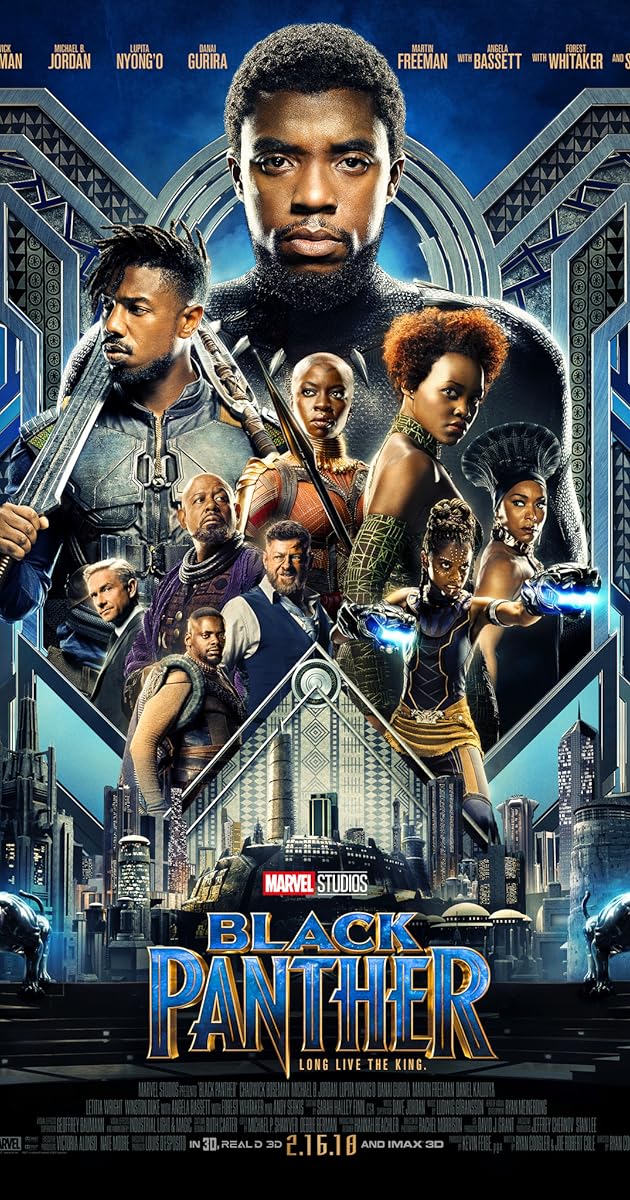
Image result for black panther poster

If you're a white boy (or girl) like me, this is likely to be your first foray into Afrofuturism. I think it might be for me, though I can't be sure -- it's not like there's a comprehensive Afrofuturist Registry or whatever. But whether it's your first encounter with Black-created science fiction or your thousandth, Black Panther offers something I can promise (with reasonable certainty) that you've never seen before: a big-budget Hollywood blockbuster movie, created by Black authors, artists, and actors, tied into a major and extremely popular shared cinematic universe, in which Blackness is not only prominent, but portrayed positively and in a way which is central to the story. Black Panther goes to places I never expected to see a Hollywood movie deal with in such a frank manner, and even goes so far as to point the blinding cultural spotlight that is the Marvel Cinematic Universe towards some disturbing and controversial truths.

Yeah, that's right: this movie asks you to consider some uncomfortable facts about race in America, Africa, and the African Diaspora. Deal with it. You'll still get to see awesome fight scenes, top-notch special effects, and subtle nods to Marvel Comics and MCU history. It's not all sad-times and serious business: there's plenty of domestic comedy, explosions, and affectionate kisses from battle-rhinos to keep you entertained.

[This review will contain mild spoilers for the first act of Black Panther, but I'll do my best not to ruin the major surprises for you.]

The tale begins with a visually-stunning infodump which explains the history of Wakanda and its massive deposits of the super-metal vibranium, as well as their decision to conceal their technological prowess from the rest of the world, and how they came to select the first Black Panther as their king. Since then, the title of king-and-Black-Panther has passed from father to son in the royal line: upon the recent assassination of King T'Chaka (John Kani) in Captain America: Civil War, the mantle passes to his son, Prince T'Challa (Chadwick Boseman).

Image result for black panther
Women are well and strongly represented; most of T'Challa's
entourage, from his bodyguards to his tech guru, are female.
(From the very first shot, I was reminded of that scene from the beginning of Roots, in which newborn Kunta Kinte is held up to take his first look at the night sky by his father, who tells his infant son "Behold! The only thing greater than yourself." In a way, Black Panther is a love-letter from Black parents (and aunts, uncles, big brothers, and big sisters), to the next generation of Black children, saying "Behold! This is how awesome your future could be; make it so.")

After that we jump ahead to Oakland, California in 1992, where King T'Chaka shows up unannounced, surprising his younger brother Prince N'Jobu (Sterling K. Brown), who has secretly been arming people of African descent with Wakandan weaponry in order to bring about revolution. T'Chaka is forced by this betrayal -- and N'Jobu's attempt on the life of T'Chaka's adviser -- to kill his younger brother, an act which will have dire consequences for T'Chaka's kingdom . . . and for his son in particular.

Next we skip ahead to the modern day where T'Challa ascends to the throne after a quick round of ritual combat. He learns that Age of Ultron villain Ulysses Klaue (Andy Serkis) -- who recently stole a sizable chunk of Wakandan vibranium and killed several people in the process -- has resurfaced in Busan, South Korea, which prompts T'Challa to round up a posse -- consisting of his ex-lover Nakia (Lupita Nyong'o) and his chief honor-guardswoman Okoye (Danai Gurira) -- and head out to bring him in. This plan of course goes south, forcing T'Challa to return empty-handed . . . or nearly so. CIA operative Everett Ross (Martin Freeman) gets caught in the crossfire of Klaue's escape (which is effected by one Erik "Killmonger" Stevens (Michael B. Jordan), a former U.S. black ops soldier and son of Prince N'Jobu, making him T'Challa's cousin), and T'Challa decides they can't leave the man to die from wounds he sustained in "their" fight. So they pack Ross onto their quinjet and take him back to Wakanda for a round of super-healing . . . which entails exposing their country's technological superiority to an outsider (and a white guy to boot!)

Image result for killmonger
Michael B. Jordan lends villain Erik Killmonger a formidable emotional range,
from a scary-intense calm to a bitter, wrathful spite.
But of course, things go from bad to worse when Killmonger shows up unexpectedly in Wakanda, revealing his hidden heritage and, by dint of his royal blood, challenging T'Challa for the throne . . . and the mantle of the Black Panther!

Alright, that's all the storyline I'm gonna spoil for you. Onward, to the review!

I don't think I've ever seen a movie with a token white guy before: it was an interesting inversion of the status quo. I also think it was a smart move on the writers' part, because by making a White man (Martin Freeman) one of the good guys, they preclude the inevitable racist braying that the film demonizes White people. The film doesn't exclude White people, neither from the protagonists nor from the antagonists, it simply takes the logical step of casting a movie set mostly in Africa with mostly people of African descent. Seems perfectly reasonable to me.

Killmonger is unusual for a Marvel villain: instead of being crazy-eyed psycho or a moustache-twirling omnicidal tyrant, Killmonger is calm and soft-spoken, almost scarily calm: a marked departure from his depiction in the comics, where he's about as restrained as Hulk Hogan. The villain was actually one of the film's strongest points (and Black Panther has a great many strong points). While he's unquestionably evil and clearly not interested in what's best for Wakanda -- or anyone else, including himself -- once we learn his backstory, he becomes . . . not exactly sympathetic exactly (we can't agree with his methods, or even his goals), we can at least understand what made him so fucked-up in the first place, and feel bad for him and his misfortune at the hands of an unjust system and his betrayal/abandonment by the people (his own flesh and blood) who should have taken him in and cared for him. 

Black Panther doesn't shy away from uncomfortable truths about the African condition, both in Africa itself and across the globe (e.g., black-on-black crime, institutionalized racism, stereotyping, the need for Pan-Africanism, etc.) As Killmonger points out (as near as I can remember the quote), "Y'all sittin' up here comfortable [while] there's about two billion people all over the world that looks like us, but their lives are a lot harder [than yours]."

Killmonger is unusually philosophical for a Marvel villain: his words (especially his final line of the film) will stay with you long after Black Panther is over. Just make sure you stay until the very, very end.

Image result for black panther

Wakanda forever!